
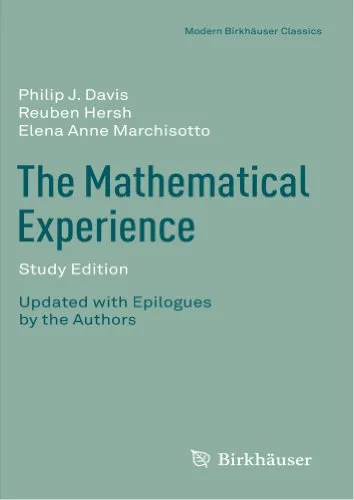
The Mathematical Experience, Study Edition
Philip J. Davis,Reuben Hersh,Elena Anne Marchisotto (auth.)
2012
View book
Book guide and evaluation
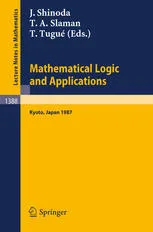
C. T. Chong (auth.),Juichi Shinoda,Tosiyuki Tugué,Theodore A. Slaman (eds.)
0 reviews
Published
pages
views
Introduction to "Mathematical Logic and Applications" "Mathematical Logic and Applications: Proceedings of the Logic Meeting held in Kyoto, 1987" is a seminal volume that captures the essence and advancements in the field of mathematical logic as presented at the prestigio
Before you read
"Mathematical Logic and Applications: Proceedings of the Logic Meeting held in Kyoto, 1987" is a seminal volume that captures the essence and advancements in the field of mathematical logic as presented at the prestigious Kyoto Logic Meeting. This book compiles a series of research papers and discussions from some of the foremost logicians and mathematicians of the era. Its relevance continues to resonate with scholars and students who delve into the intricate connections between logic, mathematics, and their applications. Edited by Juichi Shinoda, Tosiyuki Tugué, and Theodore A. Slaman, with contributions from notable authors such as C. T. Chong, this book serves both as a historical document of the constructive discourse in the field and as a springboard for further research.
The text primarily focuses on the contributions presented during the 1987 Logic Meeting held in Kyoto. Divided into various specialized topics, the proceedings explore diverse areas such as recursion theory, proof theory, set theory, model theory, and their intersections with real-world applications. The studies range from foundational theoretical concepts to practical applications that extend logic's reach into mathematical problem-solving, computer science, and philosophical reasoning.
In particular, the book emphasizes:
Each chapter delves into state-of-the-art research, providing the reader with a comprehensive overview of groundbreaking ideas and how they have shaped the field. The collaborative effort of authors not only documents progress but also highlights emerging challenges and possible future directions.
Readers of this book can expect to gain a broad understanding of key areas in mathematical logic as they stood in the late 20th century. Among the primary takeaways are:
Furthermore, the book highlights the importance of fostering global academic exchanges, as evidenced by the international participation in the Kyoto meeting. It serves as a testament to logic's universal appeal and relevance.
The book contains several thought-provoking statements and insights from influential contributors. Here are a few notable quotes:
"Mathematical logic is not merely a tool for proving theorems. It is a lens through which we examine the fundamental nature of truth and knowledge." - Contributor
"The application of recursive techniques heralds a new age of computational efficiency, bridging the gap between theory and practice." - Contributor
"Logic, in its purest form, transcends disciplines, acting as the common thread that binds together mathematics, computation, and philosophy." - Contributor
This book holds significant importance not just for logicians but for anyone interested in the rigorous applications of logic in various domains. Its role extends beyond merely documenting research; it is a cornerstone that reflects the developmental trajectory of mathematical logic.
By capturing the collaborative spirit of the Kyoto Logic Meeting, the book underscores the importance of global academic forums in fostering progress. It remains an enduring resource for researchers and students who wish to understand the evolution of the field. The ideas and methodologies presented here continue to inspire advancements in computer science, artificial intelligence, and the philosophy of mathematics.
To this day, "Mathematical Logic and Applications" serves as both a historical marker and a guide for those seeking a deeper understanding of logic’s enduring influence across disciplines.
Your question is answered in the context of this title and author. Each answer uses 2 points.
0 reviews, 4.0 average out of 5
Sign in to publish a review.
Ask a focused question and learn from the community.
Related references that continue this learning path.
Philip J. Davis,Reuben Hersh,Elena Anne Marchisotto (auth.)
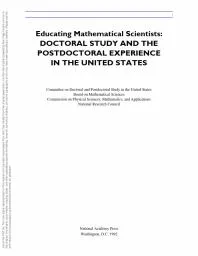
National Research Council; Committee on DoctoralandPostdoctoral Study in the United States
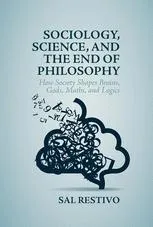
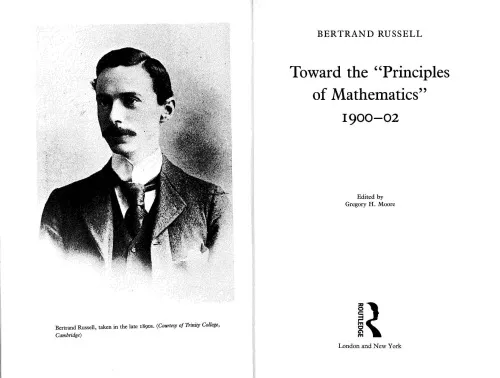
Bertrand Russell