
The Mathematical Experience, Study Edition
Philip J. Davis,Reuben Hersh,Elena Anne Marchisotto (auth.)
2012
View book
Book guide and evaluation
William P. Berlinghoff,Fernando Q. Gouvea
0 reviews
Published
pages
views
Introduction to "Math Through the Ages: A Gentle History for Teachers and Others, Expanded Edition" "Math Through the Ages: A Gentle History for Teachers and Others, Expanded Edition," written by William P. Berlinghoff and Fernando Q. Gouvêa, is an engaging exploration of the
Before you read
"Math Through the Ages: A Gentle History for Teachers and Others, Expanded Edition," written by William P. Berlinghoff and Fernando Q. Gouvêa, is an engaging exploration of the history and development of mathematics. Designed for educators, students, and anyone intrigued by the evolution of one of humankind's most significant intellectual achievements, the book combines accessibility with depth to deliver an inspiring narrative about mathematics across centuries.
Unlike most technical works on the subject, this book gracefully bridges the gap between rigorous historical analysis and an approachable storytelling style. It conveys key mathematical milestones while spotlighting the human stories behind these breakthroughs, making it an essential resource for educators and enthusiasts alike. With this expanded edition, the authors provide additional insights, refined explanations, and new material to further enrich readers' understanding of how mathematics has shaped—and been shaped by—our world.
The book is divided into two main parts: "A Brief History of Mathematics" and "Topics in the History of Mathematics."
In the first part, the authors take readers on a journey through time to trace how mathematical ideas developed across different cultures and historical periods. Starting with the ancient civilizations of Mesopotamia, Egypt, and Greece, the book discusses foundational concepts such as arithmetic, geometry, and early attempts at algebra. It then moves through the transformative periods of the Islamic Golden Age, the European Renaissance, and the rise of modern mathematics, culminating in the developments of the 19th and 20th centuries, including calculus and abstract algebra.
In the second part, the authors delve into specific topics, offering deeper insight into key mathematical ideas and their significance. These include the concept of number systems, the evolution of algebraic notation, and the interplay between geometry and art during the Renaissance. This section combines technical explanations with historical and cultural context, creating a multifaceted understanding of mathematics.
Throughout the book, accessible language, engaging anecdotes, and thoughtful examples make complex ideas easier to grasp, ensuring that the content resonates with diverse audiences, from novice learners to experienced educators.
"Mathematics is not just a collection of results and methods; it is also a way of thinking and a process of discovery."
"Perhaps the most remarkable aspect of mathematics is how it connects people across the ages, allowing ideas to travel freely through time."
"History shows us that mathematics is a living, evolving subject, deeply influenced by the needs and aspirations of each generation."
In an era where STEM education is a cornerstone of modern learning, "Math Through the Ages" provides critical perspective on the origins and evolution of the ideas that underpin this discipline. By illuminating the human side of mathematics, the book inspires readers to view the subject as more than just formulas and numbers—it is a reflection of human creativity, curiosity, and perseverance.
The book also serves as a valuable teaching tool. For educators, it offers rich material to make mathematics more engaging and relatable for students. By connecting mathematical concepts to historical milestones and real-world applications, educators can foster deeper interest and understanding.
Finally, this expanded edition includes new resources and content to address the growing interest in interdisciplinary approaches to mathematics, connecting it to art, culture, philosophy, and science. It invites readers to appreciate the beauty, utility, and enduring relevance of mathematics in shaping human knowledge and society.
Your question is answered in the context of this title and author. Each answer uses 2 points.
0 reviews, 4.6 average out of 5
Sign in to publish a review.
Ask a focused question and learn from the community.
Related references that continue this learning path.
Philip J. Davis,Reuben Hersh,Elena Anne Marchisotto (auth.)
National Research Council; Committee on DoctoralandPostdoctoral Study in the United States
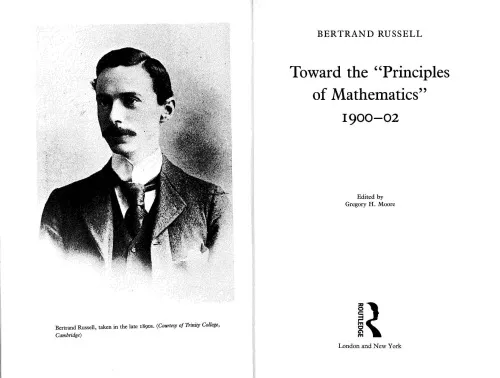
Bertrand Russell