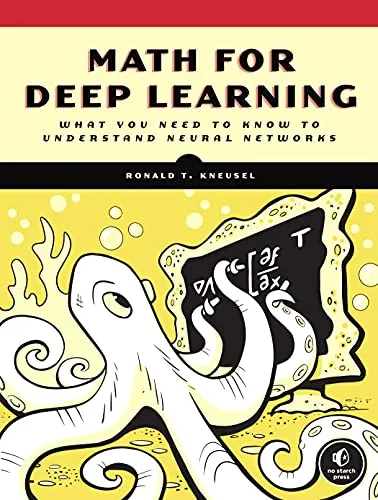
Introduction to "Math for Deep Learning: What You Need to Know to Understand Neural Networks"
In the fast-paced world of artificial intelligence and machine learning, understanding the mathematics behind deep learning is crucial for anyone aspiring to excel in this field. "Math for Deep Learning: What You Need to Know to Understand Neural Networks" provides an accessible yet comprehensive introduction to the mathematical foundations enabling neural networks. Designed for learners who already have coding and data science skills, the book builds a bridge from mathematical concepts to their practical applications in deep learning models. Whether you're a seasoned programmer, a data scientist, or a student aiming to expand your knowledge, this book empowers you to dissect and grasp the mechanics of neural networks at a deeper level.
Detailed Summary of the Book
The book begins with foundational topics, ensuring readers are comfortable with essential concepts in linear algebra, calculus, probability, and statistics. From there, it transitions into step-by-step explanations of the algorithms and architectures underpinning deep learning models. Readers will uncover linear classifiers, optimization techniques, and gradient descent, followed by explorations of neural network structures, activation functions, and training processes.
Chapters are structured to progressively deepen understanding, guiding readers through advanced topics such as convolutional neural networks (CNNs), recurrent neural networks (RNNs), generative adversarial networks (GANs), and more. Practical examples and exercises are interwoven throughout each chapter, allowing readers to apply mathematical theory directly to machine learning scenarios. The book also addresses real-world challenges like overfitting, regularization, and hyperparameter tuning, equipping readers with tools to build robust models.
What sets this book apart is its commitment to demystifying intimidating mathematical concepts without oversimplification, ensuring that readers gain a working, practical knowledge of key equations, derivations, and computational techniques relevant to deep learning.
Key Takeaways
- Understand the Basics: Learn the essential mathematical concepts—including vectors, matrices, and gradients—that are fundamental to deep learning.
- Bridge Theory and Practice: Connect mathematical theories with coding implementations used in real-world neural network models.
- Dive into Deep Learning Algorithms: Grasp the inner workings of optimization, training, and architecture of deep learning systems.
- Focus on Problem Solving: Tackle challenges such as overfitting, scaling, and fine-tuning models for better performance.
- No Overwhelming Jargon: Accessible language simplifies abstract concepts without losing technical accuracy.
Famous Quotes from the Book
"Deep learning isn’t just about using algorithms; it’s about understanding the mathematical foundation that makes those algorithms work."
"To master deep learning, you don’t need to become a mathematician, but you must learn to think mathematically."
"A neural network may seem magical, but its power lies in the equations that transform data into decisions."
Why This Book Matters
In an era where deep learning drives innovations across industries—healthcare, finance, robotics, and more—understanding its mathematical foundations is indispensable. "Math for Deep Learning" fills a critical gap, serving as an educational tool that decodes complex mathematical principles into actionable insights. For professionals in data science and software engineering, this book equips readers with the capabilities to innovate and refine neural network models.
Moreover, educators and students can rely on it as a resource for curriculum development or independent study. The book fosters clarity and confidence, allowing readers to engage deeply with deep learning frameworks like TensorFlow and PyTorch. Its relevance extends beyond academic circles, enabling practitioners and enthusiasts to demystify neural networks and build meaningful AI solutions.
In summary, "Math for Deep Learning: What You Need to Know to Understand Neural Networks" is not just another textbook—it’s a key to unlocking the transformative potential of deep learning. Its clear explanations, practical examples, and emphasis on applied knowledge make it a cornerstone resource for a growing, technology-driven world.