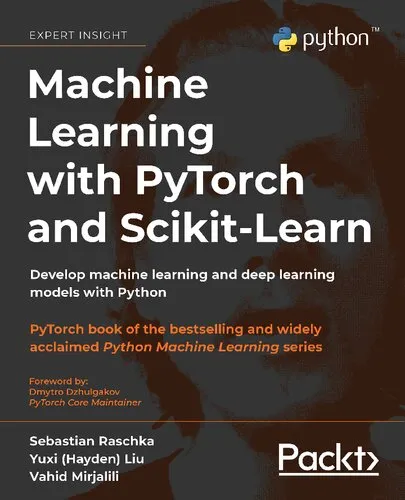
MACHINE LEARNING WITH PYTORCH AND SCIKIT-LEARN : develop machine learning and deep learning... models with scikit-learn and pytorch.
SEBASTIAN LIU YUXI (HAYDEN) MIRJALILI VAHID RASCHKA
2022
View book
Book guide and evaluation
Andrew Glassner
0 reviews
Published
pages
views
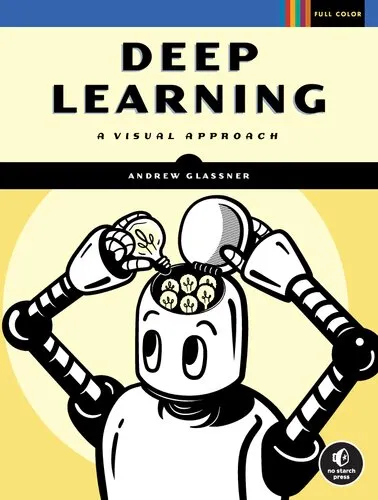
Introduction to 'Deep Learning: A Visual Approach' Welcome to Deep Learning: A Visual Approach, a unique journey into one of the most captivating and transformative technologies of our era: deep learning. This book serves as a bridge between the mathematical complexity a
Before you read
Welcome to Deep Learning: A Visual Approach, a unique journey into one of the most captivating and transformative technologies of our era: deep learning. This book serves as a bridge between the mathematical complexity and practical application of deep learning, bringing to life an otherwise technical topic through vivid illustrations, compelling visuals, and clear language.
Whether you're a curious beginner, an industry professional, or a researcher diving deeper into the field, you'll find a trusted companion in this book. Through visually intuitive explanations and engaging narratives, we demystify the inner workings of deep learning, guiding you step by step into the principles, processes, and power of modern machine learning systems.
Deep learning is a technology that powers everything from recommendation systems and language translation tools to self-driving cars and cutting-edge medical imaging. In Deep Learning: A Visual Approach, Andrew Glassner presents this cutting-edge field in a way that’s suitable for readers from all backgrounds. With a strong emphasis on visualization, complex concepts are broken down into simple, digestible explanations.
The book covers the key principles of neural networks, backpropagation, convolutional neural networks (CNNs), recurrent neural networks (RNNs), generative adversarial networks (GANs), and more. Along with these, the author explores real-world applications and ethical considerations of AI. Instead of focusing on code or extensive math, the book aims to build conceptual clarity and intuition using examples, analogies, and illustrations.
The journey starts with foundational ideas, such as how machines learn and the history of neural networks. As you progress, deeper insights into neural architectures and state-of-the-art advances in AI unfold, helping you not only understand the “how” but also the “why” of deep learning.
"Deep learning is not magic; it’s a way of looking at data differently and working within its rules to uncover its secrets."
"The greatest power of visualization in deep learning lies not only in clarity but in curiosity—an invitation to keep exploring."
"Behind every algorithm lies a creative process of engineering questions, testing ideas, and imagining the unimaginable."
Deep Learning: A Visual Approach stands out because it bridges the gap between accessible learning and advanced technical expertise. While many books on artificial intelligence dive straight into heavy mathematics, this one brings a breath of fresh air by focusing on intuition and concepts.
In an age where AI is reshaping industries, understanding deep learning isn’t just for engineers or data scientists—it’s for anyone who wants to engage meaningfully with the technology of our future. By making deep learning approachable, this book empowers readers to participate in important conversations about innovation, ethics, and the role of AI in society.
The visual approach, combined with practical insights, ensures knowledge retention and sparks creativity, making it an essential read for those eager to break into the AI domain.
Your question is answered in the context of this title and author. Each answer uses 2 points.
0 reviews, 4.5 average out of 5
Sign in to publish a review.
Ask a focused question and learn from the community.
Related references that continue this learning path.
SEBASTIAN LIU YUXI (HAYDEN) MIRJALILI VAHID RASCHKA