Book guide and evaluation
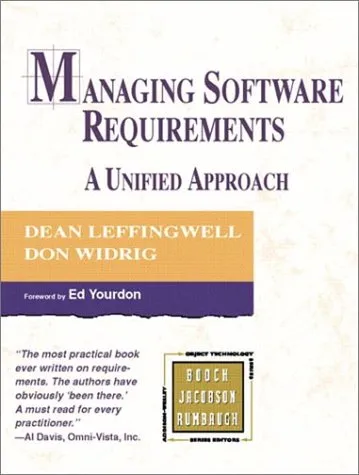
Managing software requirements: a unified approach
Dean Leffingwell,Don Widrig
English
Beginner
Software Testing
4.5 / 5
0 reviews
2000
Published
377
pages
778
views
Introduction Managing requirements is one of the most critical aspects of software development, yet it is often the most overlooked or misunderstood discipline. "Managing Software Requirements: A Unified Approach", written by Dean Leffin
Before you read
What will you get from this book?
Introduction
Managing requirements is one of the most critical aspects of software development, yet it is often the most overlooked or misunderstood discipline. "Managing Software Requirements: A Unified Approach", written by Dean Leffingwell and Don Widrig, offers a comprehensive guide to help individuals and organizations bridge the gap between business needs and development efforts. Targeted at software developers, business analysts, project managers, and stakeholders, this book presents a systematic framework for effectively capturing, analyzing, and managing software requirements, ensuring projects deliver what users need and expect.
In this introduction to the book, we'll explore its detailed summary, key takeaways, famous quotes, and reasons why this book remains vital to the software development community. Filled with practical advice, real-world examples, and a unified process model, this book empowers teams to succeed in a demanding industry where clear requirements can determine success or failure.
Detailed Summary of the Book
"Managing Software Requirements: A Unified Approach" emphasizes the importance of thoroughly understanding and documenting what users and stakeholders want before diving into development. The book introduces a unified approach that blends principles from various models, such as systems engineering and Agile software development, to create a practical and flexible requirements management methodology. The authors focus on providing teams with techniques they can adapt, regardless of the complexity of their projects or the size of their organizations.
The book begins with foundational concepts, defining critical terms like "requirements," "stakeholders," and the "software lifecycle." It then dives into discovering, analyzing, and documenting requirements, showcasing best practices along the way. Techniques for gathering insights, including user interviews, prototyping, and use-case modeling, are detailed to ensure accuracy and clarity in capturing the customer's voice. The authors also highlight the importance of managing both functional and non-functional requirements, ensuring the finished software performs as expected in real-world conditions.
A significant portion of the book is dedicated to managing the inevitable changes that occur in any development project. The authors discuss change control processes, prioritization strategies, and the tools teams can use to stay agile while maintaining accountability. Furthermore, the book provides guidance on how to incorporate a requirements management framework into an organization's existing processes smoothly, making it easier for teams to adopt and sustain.
Key Takeaways
- Effective requirements capture and management are critical to the success of software projects.
- A "one size fits all" approach doesn't work—methods must be adaptable to the project and team.
- Clear communication with stakeholders is essential for understanding and validating requirements.
- Both functional and non-functional requirements need equal attention to ensure a robust product.
- Using tools and frameworks for requirements management enhances organization and accountability.
- Change is inevitable—plan for it with structured processes and adaptable strategies.
Famous Quotes from the Book
"Inadequate requirements are the single most common reason for project failure."
"Good requirements form the foundation upon which successful software is built."
"The best systems emerge not from brilliant design but from understanding what the users truly need."
Why This Book Matters
The significance of "Managing Software Requirements: A Unified Approach" lies in its ability to bridge the communication gap between technical teams and business stakeholders. The authors have carefully crafted a guide that not only helps professionals master the art of requirements gathering but also fosters collaboration and accountability across teams. By following the principles outlined in this book, organizations can reduce development risks, improve product quality, and deliver solutions that meet or exceed user expectations.
In an era where software drives business innovation and productivity, managing requirements effectively has become a critical skill. This book empowers readers to rise above the challenges of unclear stakeholder needs, scope creep, and shifting priorities, enabling them to consistently deliver software that generates value. Whether you're a seasoned professional or new to requirements engineering, the timeless lessons in this book make it an essential read.
Ask this book
Your question is answered in the context of this title and author. Each answer uses 2 points.
Sign in to ask the book assistant.
Reader reviews
0 reviews, 4.5 average out of 5
No reviews yet
If you have read this book, help the next reader with your experience.
Write a review
Sign in to publish a review.
Reader questions and answers
Ask a focused question and learn from the community.
Sign in to ask or answer a question.
No questions yet
Be the first to ask a clear, useful question.
What to read next
Related references that continue this learning path.

Globalizing Domain-Specific Languages
Benoit Combemale,Betty H.C. Cheng,Robert B. France,Jean-Marc Jézéquel,Bernhard Rumpe (eds.)
2015
View book