Loading
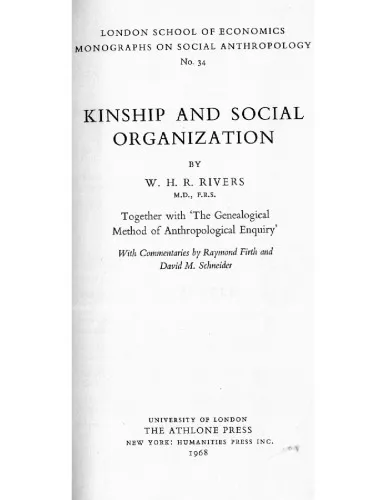
Cover of London School of Economics Monographs on Social Anthropology 34

Book guide and evaluation

London School of Economics Monographs on Social Anthropology 34

W. H. R. Rivers

English Unordered Economics
4.7 / 5

0 reviews

1968

Published

116

pages

190

views

W. H. R. Rivers, who has been called 'the founder of the modern study of social organization', exerted an immense influence on his contemporaries and successors. This volume reprints three of his lectures, delivered in 1913 and first published in 1914, which provide a short and b

Before you read

What will you get from this book?

W. H. R. Rivers, who has been called 'the founder of the modern study of social organization', exerted an immense influence on his contemporaries and successors. This volume reprints three of his lectures, delivered in 1913 and first published in 1914, which provide a short and brilliant exposition of his theoretical approach, and are exemplary of his handling of ethnographic evidence. His theme is the relationship between kinship terminologies and social organization, more particularly forms of marriage, a subject still of lively theoretical interest. Also included is the same author's The Genealogical Method of Anthropological Enquiry, first published in 1910, a classic of anthropological methodology, and Professor Raymond Firth of the London School of Economics and Professor David Schneider of the University of Chicago provide commentaries estimating the past and present importance of Rivers in British and American Anthropology respectively.

Ask this book

Your question is answered in the context of this title and author. Each answer uses 2 points.

Sign in to ask the book assistant.

Reader reviews

0 reviews, 4.7 average out of 5

No reviews yet

If you have read this book, help the next reader with your experience.

Write a review

Sign in to publish a review.

Reader questions and answers

Ask a focused question and learn from the community.

Sign in to ask or answer a question.

No questions yet

Be the first to ask a clear, useful question.