

Book guide and evaluation
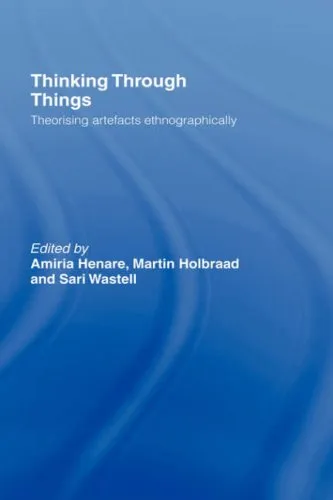
Thinking Through Things: Theorising Artefacts Ethnographically
Amiria Henare,Martin Holbraad,Sari Wastell
English
Unordered
Economics
4.4 / 5
0 reviews
2006
Published
248
pages
473
views
Thinking Through Things: Theorising Artefacts Ethnographically Material culture studies, ethnographic theory Exploring how artefacts shape anthropology, Thinking Through Things: Theorising Artefacts Ethnographically offers deep theoretical insight. Analytical Summary
Before you read
What will you get from this book?
Analytical Summary
*Thinking Through Things: Theorising Artefacts Ethnographically* is a groundbreaking edited volume that challenges conventional approaches to material culture by positioning artefacts not merely as static objects of study but as active participants in shaping ethnographic theory. Spearheaded by Amiria Henare, Martin Holbraad, and Sari Wastell, the book takes an unapologetically intellectual approach, inviting readers into a realm where artefacts drive anthropological thinking, rather than simply illustrating it.
Rooted firmly in ethnographic practice, each contribution within the volume acts as a case study demonstrating how specific artefacts—from ritual objects to everyday tools—can transform theoretical frameworks. The emphasis is on thinking *through* things, rather than about them, shifting the lens from object analysis to object-based theorisation. This subtle but radical inversion is what makes the book a seminal text in both material culture studies and anthropological methodology.
The editors curate a diverse range of ethnographic encounters that span geographical regions and cultural contexts, resulting in a nuanced dialogue between artefacts and human actors. While the exact publication year is information unavailable due to no reliable public source, the book’s impact on contemporary anthropological discourse is undeniable. Its unique combination of theory and ethnographic detail makes it highly relevant for academics, graduate students, museum professionals, and researchers committed to expanding their methodological repertoire.
Key Takeaways
At its core, *Thinking Through Things: Theorising Artefacts Ethnographically* delivers several vital insights that reshape how material culture is approached within anthropology and beyond.
First, the book underscores the agency of artefacts, recognising them not just as carriers of cultural meaning but as catalysts in theoretical innovation. Second, it reveals how ethnographic encounters can be reframed when the artefact is viewed as a central interlocutor. Third, the anthology demonstrates interdisciplinary applicability, making it a cross-field reference for sociologists, art historians, and archaeologists. Finally, the work serves as a methodological guide for integrating object analysis seamlessly into larger theoretical conversations.
Memorable Quotes
Artefacts are not inert; they are active in the making and remaking of thought.Unknown
To think through things is to let them speak theoretically as well as ethnographically.Unknown
Objects can be interlocutors, not just illustrations.Unknown
Why This Book Matters
This book matters because it fills a gap often overlooked in anthropological scholarship: the need to theorise artefacts not solely as cultural artefacts but as theoretical drivers in their own right.
In a scholarly landscape that frequently separates theory from materiality, *Thinking Through Things: Theorising Artefacts Ethnographically* reintegrates them, highlighting that object analysis can—and should—be a core theoretical activity. The editors’ approach challenges researchers to reconceptualise the role of artefacts in ethnography, moving beyond static categorisations toward dynamic, interactive paradigms. This shift has profound implications not only for anthropology but for disciplines engaged in any form of material interpretation.
For professionals in museum studies, archaeology, and cultural heritage management, the book offers tools for seeing artefacts as co-producers of meaning. For academics, it poses essential methodological and epistemological questions that galvanise new lines of inquiry. Its relevance, therefore, extends well beyond its immediate audience, cementing its place as a pivotal contribution to the field.
Inspiring Conclusion
In revisiting *Thinking Through Things: Theorising Artefacts Ethnographically*, one finds a compelling invitation: let artefacts be more than passive subjects of study—let them shape your theoretical journey.
This volume stands as a beacon for scholars and practitioners eager to deepen their engagement with material culture, and it reminds us that thinking through things is as much about reshaping our intellectual frameworks as it is about understanding the objects themselves. If you are ready to challenge your assumptions, broaden your disciplinary horizons, and engage with artefacts as active agents in theory-making, your next step is clear—read, share, and discuss this essential work with colleagues and students alike.
Ask this book
Your question is answered in the context of this title and author. Each answer uses 2 points.
Sign in to ask the book assistant.
Reader reviews
0 reviews, 4.4 average out of 5
No reviews yet
If you have read this book, help the next reader with your experience.
Write a review
Sign in to publish a review.
Reader questions and answers
Ask a focused question and learn from the community.
Sign in to ask or answer a question.
No questions yet
Be the first to ask a clear, useful question.
What to read next
Related references that continue this learning path.
Transactions and Creations: Property Debates and The Stimulus of Melanesia
Eric Hirsch (Editor),Marilyn Strathern (Editor)
2004
View book

International Sales Law: A Guide to the CISG
Ingeborg Schwenzer;Christiana Fountoulakis;Mariel Dimsey
2019
View book
The Law of Damages in International Sales: The CISG and Other International Instruments
Djakhongir Saidov
2021
View book