
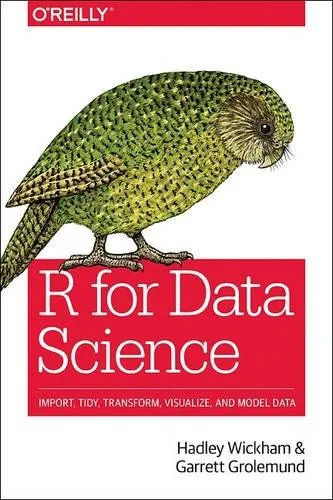
R for Data Science: Import, Tidy, Transform, Visualize, and Model Data
Hadley Wickham,Garrett Grolemund
2017
View book
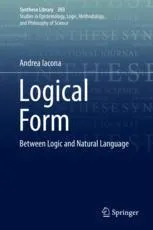
Book guide and evaluation
Andrea Iacona (auth.)
0 reviews
Published
pages
views
Introduction to "Logical Form: Between Logic and Natural Language" "Logical Form: Between Logic and Natural Language" by Andrea Iacona is a deep and comprehensive exploration of the concept of logical form, bridging the disciplines of formal logic and natural language. Thi
Before you read
"Logical Form: Between Logic and Natural Language" by Andrea Iacona is a deep and comprehensive exploration of the concept of logical form, bridging the disciplines of formal logic and natural language. This book provides an insightful investigation into how logical structures align with the intricate patterns of natural language, emphasizing their relevance in both philosophy and linguistics. Iacona methodically examines the intricate relationship between the way humans communicate and the formal systems used to structure reasoning.
Designed to be informative yet approachable, this book addresses fundamental issues at the intersection of logic, philosophy, and linguistic analysis. It is an essential resource for readers who wish to better understand how logical reasoning interacts with language's expressive power. Through clear discussions and illustrative examples, Iacona unpacks the layers of complexity surrounding logical form, making the book a must-read for scholars and students alike.
At its core, the book provides a thorough examination of logical form, a foundational concept in modern logic and linguistics. Logical form is presented as the structural representation of sentences that reveals their underlying logical properties. Iacona investigates how logical form functions as a bridge between formal systems and the nuances of human communication.
The book explores questions such as: What is the nature of logical form? How do natural language expressions encode logical contents? How can logical form illuminate the structure of arguments as conveyed through ordinary language? Iacona argues that logical form is neither entirely reducible to formal logic nor wholly grounded in natural linguistic conventions; rather, it occupies a middle ground between the two.
Divided into carefully outlined chapters, "Logical Form: Between Logic and Natural Language" delves into the history of logical theories, key debates in philosophy, and practical examples illustrating the interaction between logic and language. Facts, concepts, and arguments are presented in a nuanced yet accessible way, fostering a profound understanding of the intersection between these domains.
"Logical form is the skeleton that supports both language and reasoning, a bridge that connects the way we think with the way we speak."
"To understand the logic of natural language is to uncover its underlying architecture, the framework that makes human thought expressible."
"The interplay between natural language and logic is not one of mere translation; it is a complex negotiation of meaning."
"Logical Form: Between Logic and Natural Language" stands out as a critical resource for anyone interested in understanding the complex relationship between language and logic. The book's relevance spans a variety of fields, including philosophy, linguistics, cognitive science, and computer science. Iacona's rigorous analysis and clear explanations make it accessible to experts and newcomers alike, ensuring that readers from diverse backgrounds can grasp the importance of logical form.
Furthermore, this book sheds light on why logical form is a crucial tool for clarifying ambiguity in natural language, enhancing the precision of reasoning, and facilitating effective communication. By blending theoretical and practical insights, it serves as a guide for navigating the challenges that arise in both spoken and written discourse.
Through its interdisciplinary nature, "Logical Form: Between Logic and Natural Language" bridges gaps between disciplines, emphasizing how understanding one can deepen our appreciation of the other. It invites readers to critically evaluate how we convey meaning and reason logically in everyday life, offering tools and insights to refine both linguistic and analytical skills.
Your question is answered in the context of this title and author. Each answer uses 2 points.
0 reviews, 4.5 average out of 5
Sign in to publish a review.
Ask a focused question and learn from the community.
Related references that continue this learning path.
Hadley Wickham,Garrett Grolemund
Christopher D Manning;Prabhakar Raghavan;Hinrich Schutze