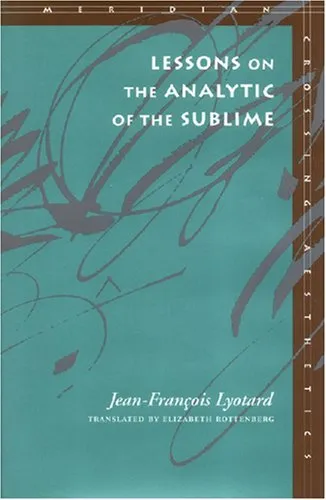
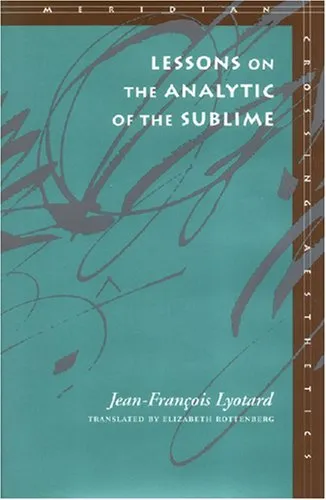
Lessons on the Analytic of the Sublime (Meridian: Crossing Aesthetics)
Jean-Francois Lyotard
1994
View book
Book guide and evaluation
Jean-Francois Lyotard
0 reviews
Published
pages
views
Welcome to an exploration of one of the most profound philosophical texts crafted by Jean-Francois Lyotard: "Lessons on the Analytic of the Sublime." This work meticulously analyzes sections 23-29 of Kant's "Critique of Judgment," delving deep into the concept of the
Before you read
Welcome to an exploration of one of the most profound philosophical texts crafted by Jean-Francois Lyotard: "Lessons on the Analytic of the Sublime." This work meticulously analyzes sections 23-29 of Kant's "Critique of Judgment," delving deep into the concept of the sublime and its implications for aesthetics, ethics, and politics. Lyotard's insightful critique and interpretation of Kant's ideas make this book an essential read for anyone eager to engage with the intricacies of philosophical aesthetics and postmodern thought.
Jean-Francois Lyotard's "Lessons on the Analytic of the Sublime" serves as a rigorous examination of Immanuel Kant's definition and exploration of the sublime, a concept pivotal to understanding both aesthetic and metaphysical realms. Focused on sections 23-29 of Kant's "Critique of Judgment," Lyotard guides readers through an intricate narrative that interprets the sublime as an experience of vastness and power that transcends rationality and empirical understanding.
Lyotard interprets Kant's notion of the sublime as a critical turning point where the limits of human cognition meet the overwhelming forces of nature or ideas, embarking on a confrontation between reason and imagination. This engagement occurs primarily when the imagination fails to comprehend the magnitude of an experience, thereby leading to a comprehension of reason's superior power.
While Kant saw the sublime as a respectful humbling of human faculties before the infinite or the almighty (such as sublime nature), Lyotard sees an opportunity for a postmodern critique of totalities, thus allowing for a multitude of smaller narratives instead. This pivotal divergence from Kant to Lyotard's understanding reflects modern advances in aesthetics and postmodern philosophy.
"The sublime offers a critique not merely of aesthetics but points towards a possible reconfiguration of social and political thought."
"Kant teaches us that the sublime must move beyond mere understanding and appreciation, venturing into the territory of critical self-examination."
Lyotard's "Lessons on the Analytic of the Sublime" is of immense importance as it bridges the gap between classical philosophical thought and contemporary interpretations. By reconstructing Kant's exploration through a postmodern lens, Lyotard opens new avenues for discussing and understanding beauty, judgment, and the transcendent nature of human experience.
This book is crucial for students and scholars of philosophy, especially those interested in Kantian studies, aesthetics, and postmodernism, as it offers insights into how past philosophical inquiries can be contextualized within modern discourse. Furthermore, Lyotard's meticulous analysis of the sublime has implications that resonate beyond aesthetics, impacting areas such as ethics and politics, thus marking its relevance in contemporary debates.
Your question is answered in the context of this title and author. Each answer uses 2 points.
0 reviews, 4.0 average out of 5
Sign in to publish a review.
Ask a focused question and learn from the community.
Related references that continue this learning path.
Jean-Francois Lyotard