
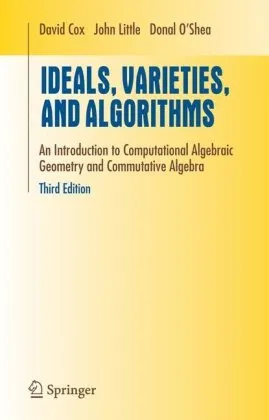
Ideals, varieties, and algorithms: an introduction to computational algebraic geometry and commutative algebra
David A. Cox,John Little,Donal O’Shea
2007
View book
Book guide and evaluation
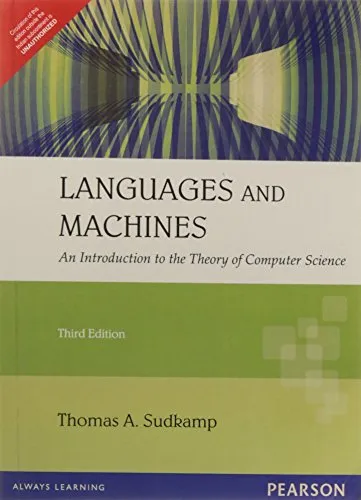
Thomas A. Sudkamp
0 reviews
Published
pages
views
Introduction to "Languages and Machines: An Introduction to the Theory of Computer Science (2nd Edition)" "Languages and Machines: An Introduction to the Theory of Computer Science (2nd Edition)" by Thomas A. Sudkamp is an essential text for those seeking an in-depth understan
Before you read
"Languages and Machines: An Introduction to the Theory of Computer Science (2nd Edition)" by Thomas A. Sudkamp is an essential text for those seeking an in-depth understanding of the foundations of theoretical computer science. The book serves as a comprehensive guide to formal languages, automata theory, computation, and the mathematical underpinnings of these topics.
This book is designed for students, educators, and professionals who are eager to explore the core concepts that define computer science theory. Combining clarity, rigor, and a structured approach, it simplifies complex topics while maintaining mathematical precision. Whether you are new to the field or revisiting core principles, this book provides the tools to gain mastery in understanding how machines process, compute, and interpret information through formal systems.
The second edition of "Languages and Machines" delivers an updated and thoroughly refined exploration of computer science theory. This edition builds upon the success of its predecessor by introducing more nuanced examples, updated exercises, and expanded explanations.
The book primarily revolves around the relationship between computer systems and computational processes. It focuses heavily on three key areas:
The book progresses methodically, introducing readers to preliminary mathematical tools like sets, logic, and functions before diving into formal languages, regular grammars, and automata. Context-free grammars and pushdown automata are explored in depth, leading to the analysis of Turing machines and the computational limits they present. In the latter chapters, the book delves into computational complexity and explores some of the most thought-provoking and unsolved questions in computer science.
Readers of "Languages and Machines" will leave with a transformed understanding of computer science and its theoretical essence. The key benefits of studying this book are:
Each chapter is structured to build on the previous one, ensuring a clear, logical progression through the material. Exercises, examples, and problems reinforce learning and provide opportunities for hands-on application.
Thomas A. Sudkamp's writing is both insightful and thought-provoking. Here are some memorable quotes from the text:
"Languages are the cornerstone of computation, linking the abstract with the practical."
"The study of automata is not an end in itself but a means to understand the very essence of computation."
"To understand what a machine can and cannot do is to gain insight into the limits of human thought."
These quotes capture the essence of the book, emphasizing the profound connection between theoretical exploration and practical application.
"Languages and Machines: An Introduction to the Theory of Computer Science (2nd Edition)" is more than just a textbook—it is a cornerstone in the study of theoretical computer science. Here’s why it has proven to be an indispensable guide for learners:
For anyone pursuing a career in computer science or seeking to understand the mathematical theories behind how machines work and think, this book is an invaluable companion.
Your question is answered in the context of this title and author. Each answer uses 2 points.
0 reviews, 4.0 average out of 5
Sign in to publish a review.
Ask a focused question and learn from the community.
Related references that continue this learning path.
David A. Cox,John Little,Donal O’Shea
Law C.,Lee E.K.,Ramzan Z.,Michael Sipser
Michael T. Goodrich,Roberto Tamassia,Michael H. Goldwasser