
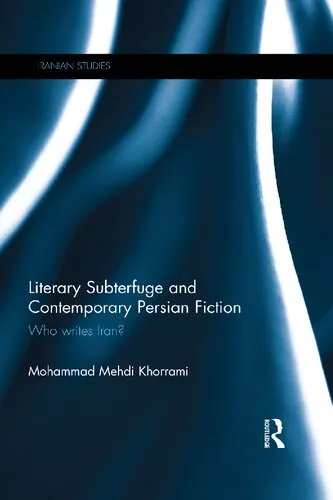
Literary Subterfuge and Contemporary Persian Fiction: Who Writes Iran?
Mohammad Mehdi Khorrami
2014
View book
Book guide and evaluation
David B. Kronenfeld
0 reviews
Published
pages
views
Language Sciencespp.424—435 linguistic anthropology, discourse analysis A deep dive into Language Sciencespp.424—435, exploring complex ideas in linguistic anthropology and discourse analysis. Analytical Summary The book Language Sciencespp.424—435, authored by Da
Before you read
The book Language Sciencespp.424—435, authored by David B. Kronenfeld, invites readers into an in-depth examination of the intricacies of language as both a social and cognitive phenomenon. While specific publication date or awards are unavailable due to no reliable public source, the work offers a focused treatment of themes central to linguistic anthropology and discourse analysis.
This section of the larger Language Sciences discourse intentionally bridges theoretical perspectives with empirical studies, allowing professionals and academics to grasp not only the fundamentals but also the nuanced interplay between language structures and social behavior. Readers encounter a robust engagement with meaning-making processes, cultural contexts, and communicative practices across diverse populations.
What sets Language Sciencespp.424—435 apart is its authoritative yet accessible synthesis of research findings, which serve both as a reference for specialists and as an invitation for interdisciplinary engagement. The narrative flows from foundational concepts through to analytical models, forming a logical progression that supports clarity and intellectual rigor.
Readers will gain several essential insights from Language Sciencespp.424—435, each of which reinforces the book’s value as a cornerstone text in the field.
First, it foregrounds the reciprocal relationship between linguistic form and social function, demonstrating that meaning is always context-dependent.
Second, it illustrates how the apparatus of discourse analysis can be applied to real-world examples, showcasing how language both reflects and shapes societal norms.
Third, it provides academically rigorous methodologies useful for future research, encouraging replication and adaptation in various sociolinguistic settings.
Fourth, it emphasizes the multifaceted nature of language and urges scholars to consider both micro-level conversation details and macro-level cultural narratives.
Finally, it nurtures an appreciation for the ongoing dialogue between different subfields of language sciences, underscoring the importance of cross-disciplinary collaboration.
Language exists not in isolation, but as a system embedded in social life.Unknown
Understanding discourse is to understand the fabric of human interaction.Unknown
Every utterance carries with it the weight of culture, context, and intent.Unknown
Language Sciencespp.424—435 is more than a scholarly text; it is an intellectual catalyst for exploring how language underpins societal structures.
Its dual emphasis on detailed linguistic analysis and broader cultural implications positions it as essential reading for both seasoned researchers and those entering the field. The book’s authoritative perspective on linguistic anthropology and discourse analysis ensures that it will remain relevant despite the absence of precise publication metadata.
The volume encourages readers to challenge assumptions, interrogate methodologies, and deepen their understanding of communication processes. It is especially valuable for designing and conducting research that is culturally sensitive yet analytically rigorous.
Through careful reading and thoughtful reflection, Language Sciencespp.424—435 challenges us to reconsider how language shapes — and is shaped by — the world we inhabit.
By engaging deeply with the text, scholars can refine their analytical skills, adapt robust methodologies, and contribute meaningfully to ongoing scholarly debates. The inclusion of linguistic anthropology and discourse analysis as recurring themes makes it an ideal reference for collaborative research and academic discourse.
If you are committed to advancing your expertise or sparking meaningful discussion within your professional community, make Language Sciencespp.424—435 a part of your journey. Read it, share it, and discuss it — your perspective on language will never be the same.
Your question is answered in the context of this title and author. Each answer uses 2 points.
0 reviews, 4.9 average out of 5
Sign in to publish a review.
Ask a focused question and learn from the community.
Related references that continue this learning path.
Mohammad Mehdi Khorrami

Noam Chomsky,James McGilvray