

SOFTWARE ARCHITECTURE WITH C# 10 AND .NET 6 : develop software solutions using... microservices, devops, ef core, and design pattern.
GABRIEL ABBRUZZESE FRANCESCO BAPTISTA
2022
View book
Book guide and evaluation
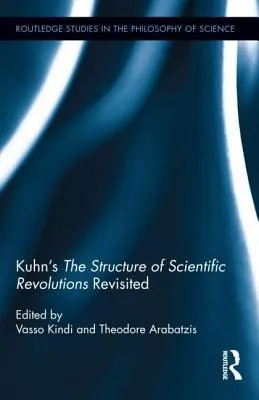
Vasso Kindi;Theodore Arabatzis
0 reviews
Published
pages
views
Welcome to an in-depth exploration of Thomas Kuhn's groundbreaking work, "The Structure of Scientific Revolutions," through our detailed commentary and analysis, "Kuhn’s the Structure of Scientific Revolutions Revisited." This book revisits and examines the profound implication
Before you read
Welcome to an in-depth exploration of Thomas Kuhn's groundbreaking work, "The Structure of Scientific Revolutions," through our detailed commentary and analysis, "Kuhn’s the Structure of Scientific Revolutions Revisited." This book revisits and examines the profound implications Kuhn's ideas have on the philosophy of science, the nature of scientific discovery, and intellectual discourse at large.
Kuhn’s "The Structure of Scientific Revolutions Revisited" meticulously deconstructs the foundational concepts introduced by Thomas Kuhn in his seminal work. Originally published in 1962, Kuhn's book introduced the revolutionary concept of "paradigm shifts," fundamentally altering the way we understand scientific progress. He challenged the prevailing view of science as a linear accumulation of knowledge, proposing instead that science undergoes periodic revolutions that reshape the landscape of what is considered knowledge.
This revisitation of Kuhn's work provides a comprehensive analysis of these paradigm shifts, delving into their nature, triggers, and impacts. The authors explore how Kuhn’s ideas have permeated not only scientific circles but also fields as diverse as sociology, political science, and even cultural studies. This book seeks to provide readers with a deeper understanding of how scientific paradigms emerge, flourish, and eventually get replaced, offering insights into how these shifts can be identified and understood within the modern scientific community.
Paradigm Shifts: Learn about the transition periods in scientific history where fundamental frameworks undergo transformation, altering how researchers perceive established truths.
Non-linear Progression: Understand the non-linear progression of science, where periods of 'normal science' are disrupted by revolutionary changes leading to new paradigms.
Interdisciplinary Impact: Discover how Kuhn’s ideas have influenced a wide array of academic disciplines, fundamentally questioning the nature of progress in these fields.
Evolution of Scientific Thought: Gain insights into how internal and external factors contribute to the evolution of scientific thought and practice.
While the revisit does not aim to simply echo Kuhn's original words, it sheds light on some of his most thought-provoking assertions, such as:
"The man who is striving to solve a problem defined by existing knowledge and technique is not, however, just looking around. He knows what he wants to achieve, and he designs his instruments and directs his thoughts accordingly."
"Scientific revolutions, as a special sort of change involving a certain type of developmental process, correspond significantly to Kuhn's depiction of crisis and renewal."
The relevance of "Kuhn’s the Structure of Scientific Revolutions Revisited" lies in its ability to provide a framework within which the fluid nature of science can be understood. In an era characterized by rapid technological and scientific advancements, this book is crucial for educators, researchers, and policymakers. It explores the mechanisms of change and continuity in scientific practice, offering insights that are vital for anyone engaged in the pursuit of knowledge.
Furthermore, by engaging in a critical dialogue with Kuhn's original texts, the book serves not just as a reiteration of Kuhn's ideas but as an enrichment of them, relevant to current and future scientific inquiries and academic debates. Whether you are a seasoned philosopher, a practicing scientist, or simply a curious mind, this book will reorient your understanding of how scientific revolutions shape our understanding of the world.
Your question is answered in the context of this title and author. Each answer uses 2 points.
0 reviews, 4.0 average out of 5
Sign in to publish a review.
Ask a focused question and learn from the community.
Related references that continue this learning path.
GABRIEL ABBRUZZESE FRANCESCO BAPTISTA

Gabriel Baptista,Francesco Abbruzzese