
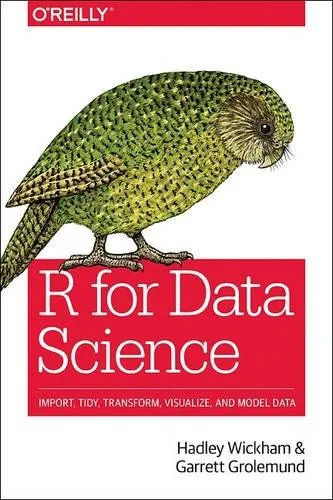
R for Data Science: Import, Tidy, Transform, Visualize, and Model Data
Hadley Wickham,Garrett Grolemund
2017
View book
Book guide and evaluation
Bozena Kostek
0 reviews
Published
pages
views
Introduction to the Book Kernel Based Algorithms for Mining Huge Data Sets: Supervised, Semi-supervised, and Unsupervised Learning explores the frontier of machine learning methodologies tailored for large-scale data mining probl
Before you read
Kernel Based Algorithms for Mining Huge Data Sets: Supervised, Semi-supervised, and Unsupervised Learning explores the frontier of machine learning methodologies tailored for large-scale data mining problems. In today's data-driven era, the overwhelming volume and complexity of data necessitate innovative approaches for effective processing, analysis, and decision-making. This book is a comprehensive resource that equips readers with both theoretical underpinnings and practical algorithms to harness the power of kernel-based methods for supervised, semi-supervised, and unsupervised learning.
Whether you are a seasoned data scientist, an academic researcher, or a practitioner venturing into the realm of Big Data, this book addresses the challenges associated with mining massive datasets while detailing state-of-the-art solutions. It delves into valuable areas like feature transformation, scalability, and model optimization, making it an essential companion for anyone navigating the complexities of machine learning workflows.
The book begins by laying the groundwork with a solid foundation in kernel-based methods, an essential class of algorithms known for their ability to handle non-linear relationships in data. The introductory chapters emphasize the theoretical aspects of kernel functions and their applications in supporting tasks like classification, clustering, and regression.
Moving forward, the book delves into the intricacies of supervised learning and highlights critical topics such as Support Vector Machines (SVMs), kernel ridge regression, and their tailored adaptations for large-scale datasets. It then transitions into semi-supervised learning, where only a portion of labeled data is available, a common scenario in the real-world context of unstructured data abundance. Techniques like manifold regularization and graph-based models are thoroughly discussed.
The text also dedicates significant attention to unsupervised learning methods, exploring clustering techniques, dimensionality reduction, and spectral methods powered by kernels. With these techniques, the book presents hands-on solutions for real-world challenges, including document clustering, image segmentation, and social network analysis.
To address computational scalability, the book integrates distributed learning approaches and adaptive algorithms, highlighting frameworks and strategies for mining datasets that stretch beyond the limits of conventional computing systems. Computational tricks, such as kernel approximations and low-rank matrix factorizations, are explored to achieve balance between precision and computational efficiency.
"Kernel-based algorithms are powerful because they allow us to project our data into a higher-dimensional space without explicitly calculating that space—bringing simplicity to complexity."
"In the age of huge data sets, scalability is not just a luxury; it's a necessity. Our ability to mine value from data lies in bridging the gap between computational feasibility and theoretical rigor."
"Semi-supervised learning stands as a bridge between data abundance and data scarcity, taking small signals and amplifying them through the lens of the unlabeled majority."
Data science and machine learning have become integral components of disciplines ranging from business analytics to scientific discovery. As the volume of data continues to grow exponentially, traditional algorithms often fail to scale or adapt to the intricate patterns hidden within such massive datasets. This book addresses those gaps by emphasizing kernel-based algorithms that excel in capturing complex relationships while maintaining computational efficiency.
Unlike other texts that focus solely on theoretical foundations, this book bridges the divide between research and practice, ensuring that readers not only understand the 'how' but also the 'why' of kernel methods. By providing detailed insights into supervised, semi-supervised, and unsupervised learning, readers are empowered to tackle diverse challenges ranging from real-time data analytics to high-dimensional processing in industries like finance, healthcare, and artificial intelligence.
Armed with cutting-edge methodologies, practical advice, and real-world examples, this book is a must-read for those seeking to thrive in the era of Big Data and unlock transformative insights from their data-driven systems.
Your question is answered in the context of this title and author. Each answer uses 2 points.
0 reviews, 4.0 average out of 5
Sign in to publish a review.
Ask a focused question and learn from the community.
Related references that continue this learning path.
Hadley Wickham,Garrett Grolemund
Christopher D Manning;Prabhakar Raghavan;Hinrich Schutze
Mihai Surdeanu,Marco Antonio Valenzuela-Escarcega