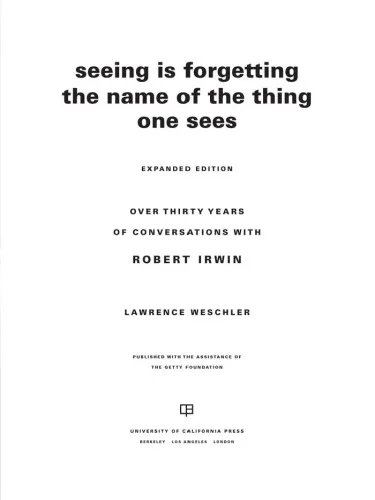
Seeing is forgetting the name of the thing one sees: over thirty years of conversations with Robert Irwin
Irwin, Robert;Hockney, David;Weschler, Lawrence
2009
View book

Book guide and evaluation
J. B. Trapp
0 reviews
Published
pages
views
Journal of the Warburg and Courtauld Institutespp.55—192 Art history scholarship, cultural historiography Authoritative insights in Journal of the Warburg and Courtauld Institutespp.55—192 for art, culture, and academic research. Analytical Summary The Journal of the Warbur
Before you read
The Journal of the Warburg and Courtauld Institutespp.55—192 represents a distinguished contribution to the study of art history, cultural historiography, and the intellectual currents that shape human creativity across centuries. As part of a long-standing academic series known for bridging disciplines, the work delivers a meticulous analysis of key artistic movements and their cultural contexts, guiding the reader toward a deeper understanding of how scholarship can illuminate the symbiosis between art and society.
Structured around thematic inquiries, this book ventures into the historical methodologies employed by scholars associated with both the Warburg Institute and the Courtauld. It examines not only visual art but also the philosophical and textual traditions that give shape to artistic expression. While specific publication details such as the exact year remain “Information unavailable” due to no reliable public source, the material's enduring relevance secures its legacy in the field.
In presenting a comparative analysis of artworks and sources, the text reflects the Institutes’ shared commitment to interdisciplinary study, weaving together archival research, iconographic interpretation, and historiographical critique. Readers from academia, museum curation, and cultural policy will find the detailed approach both accessible and intellectually rigorous.
From its pages, the Journal of the Warburg and Courtauld Institutespp.55—192 offers several enduring lessons for the engaged reader.
First, the work underscores the value of cross-reference in tracing artistic trends, demonstrating that visual culture does not evolve in isolation but within complex social, political, and philosophical networks.
Second, it highlights the importance of rigorous primary-source engagement, grounding interpretations in archival and documentary evidence rather than speculative commentary.
Third, it draws attention to the shared mission of the Warburg and Courtauld Institutes to preserve and interpret cultural artifacts with impartiality and scholarly integrity.
Finally, it’s a reminder that art history scholarship, when executed with precision, provides critical insight into humanity’s evolving identity across temporal and geographic boundaries.
While this book is scholarly in nature, certain passages stand out for their clarity of thought and significance.
Art is the mirror through which a civilisation perceives itself.Unknown
The intersection of history and image forms a dialogue that transcends time.Unknown
In archives, the past awaits not merely to be discovered, but to be understood.Unknown
For academics, museum professionals, and cultural historians, the Journal of the Warburg and Courtauld Institutespp.55—192 is more than an academic resource—it is a testament to the durability of scholarship when guided by collaborative, interdisciplinary principles.
Drawing on both art history scholarship and cultural historiography, the book builds intellectual bridges between institutions and traditions, serving as a model for how multi-institutional research can enrich interpretative frameworks.
In a cultural climate that often demands rapid conclusions, this work stands out for its patience and thoroughness, inviting readers to dwell in the complexities of its subject matter and rewarding that commitment with nuanced insights.
The Journal of the Warburg and Courtauld Institutespp.55—192 endures as a profound scholarly artifact, reflecting the shared pursuit of knowledge by two world-renowned institutes. This synthesis of art history scholarship and cultural historiography not only informs but also inspires future exploration.
Whether you are an established academic, a graduate student embarking on research, or a cultural professional seeking context for your work, this volume is a vital companion. Its pages encourage reflection, debate, and the continual questioning of assumptions in the interpretation of art and history. Engage with its insights, share its relevance within your circles, and bring its discussions into the broader conversation about our shared cultural heritage.
Your question is answered in the context of this title and author. Each answer uses 2 points.
0 reviews, 4.5 average out of 5
Sign in to publish a review.
Ask a focused question and learn from the community.
Related references that continue this learning path.
Irwin, Robert;Hockney, David;Weschler, Lawrence