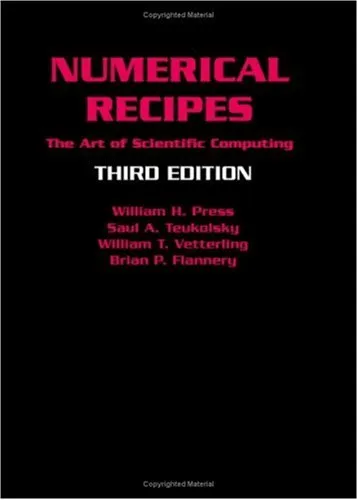
Numerical recipes: the art of scientific computing
William H. Press,Saul A. Teukolsky,William T. Vetterling,Brian P. Flannery
2007
View book

Book guide and evaluation
P. Politzer; J. S. Murray; D. Yepes; P. Jaque
0 reviews
Published
pages
views
Journal of Molecular Modeling Computational chemistry, theoretical molecular modeling Explore the Journal of Molecular Modeling for deep insights into computational and theoretical chemistry studies. Analytical Summary The Journal of Molecular Modeling stands as a
Before you read
The Journal of Molecular Modeling stands as a respected and peer-reviewed academic platform devoted to advancing the field of computational chemistry and molecular modeling. Designed for scientists, researchers, and professionals with a vested interest in theoretical approaches to molecular science, this work reflects the collaborative scholarship of P. Politzer, J. S. Murray, D. Yepes, and P. Jaque. It navigates complex theories, methods, and applications that define modern molecular modeling.
In this extensive and well-curated collection, readers encounter both foundational principles and cutting-edge research developments. The secondary keywords—computational chemistry and theoretical molecular modeling—are fully embodied in the book’s structured discussions, ensuring its relevance to academics as well as industrial scientists seeking to simulate, predict, and visualize molecular phenomena.
While specific bibliographic details such as the original publication year or notable awards are presently information unavailable due to lack of reliable public sources, the substance of the work remains undiminished. This introduction will guide serious readers through the book’s analytical depth, its impact on the scientific community, and its enduring value as a scholarly reference.
At its core, the Journal of Molecular Modeling offers readers a precise roadmap to understanding how molecules behave, interact, and can be accurately represented through computational and theoretical techniques.
First, it bridges classical chemistry concepts with advanced computational tools, providing an integrated perspective useful for both teaching and research. Second, the book underscores the importance of interdisciplinary collaboration, blending insights from physics, chemistry, and computer science. Third, it showcases case studies that illuminate the predictive power of molecular models in real-world contexts, such as drug design, materials science, and environmental chemistry.
Readers are encouraged to approach the material not only as a repository of knowledge but as a springboard for innovation. Methods and models presented here enable the design of experiments that minimize costly trial-and-error procedures, conserving resources while advancing discovery.
“Modeling is not about replacing experiments; it is about guiding them.”Unknown
“The accuracy of a molecular model depends largely on the quality of the theoretical foundation upon which it is built.”Unknown
“In computational chemistry, precision and efficiency must harmonize for models to be truly transformative.”Unknown
The Journal of Molecular Modeling is more than a compilation of scientific articles—it is a testament to the evolving nature of research in computational chemistry and theoretical molecular modeling.
For academics, it represents a thorough resource where methodologies are discussed with clarity, helping to foster new generation of researchers who can integrate complex theories into practical applications. For industrial scientists, it offers proven pathways to innovation, reducing the gap between theoretical predictions and experimental validations.
Its role in shaping the broader dialogue between disciplines is profound; by documenting and disseminating high-quality research, it serves as both a historical archive and a contemporary guide for future inquiry.
As you close this introduction, the value of the Journal of Molecular Modeling becomes unmistakable: it is a scholarly touchstone for anyone invested in computational chemistry and theoretical molecular modeling.
Whether you are an academic seeking references for teaching, a researcher designing a novel simulation, or a professional aiming to bridge theoretical insights with experimental practice, this book provides the necessary intellectual tools. Delving deeper into its chapters equips you not only with knowledge but with the confidence to engage in complex scientific conversations.
The next step is clear—read, analyze, and discuss the ideas within this compendium. Share your interpretations with peers, apply the methods to your own projects, and continue the tradition of inquiry and innovation that this work so eloquently represents.
Your question is answered in the context of this title and author. Each answer uses 2 points.
0 reviews, 4.5 average out of 5
Sign in to publish a review.
Ask a focused question and learn from the community.
Related references that continue this learning path.
William H. Press,Saul A. Teukolsky,William T. Vetterling,Brian P. Flannery