Book guide and evaluation
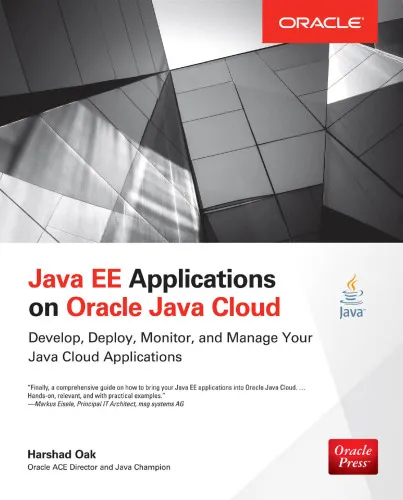
Java Ee Applications on Oracle Java Cloud: Develop, Deploy, Monitor, and Manage Your Java Cloud Applications: Develop, Deploy, Monitor, and Manage Your Java Cloud Applications
Harshad Oak
English
Unordered
Cloud Computing
4.0 / 5
0 reviews
2014
Published
290
pages
162
views
Java Ee Applications on Oracle Java Cloud: Develop, Deploy, Monitor, and Manage Your Java Cloud Applications: Develop, Deploy, Monitor, and Manage Your Java Cloud Applications Oracle Java Cloud development, Java EE deployment best practices Authoritative guide to Java E
Before you read
What will you get from this book?
Analytical Summary
The book Java Ee Applications on Oracle Java Cloud: Develop, Deploy, Monitor, and Manage Your Java Cloud Applications: Develop, Deploy, Monitor, and Manage Your Java Cloud Applications offers a deep, structured exploration into the lifecycle of enterprise-grade Java EE applications in the Oracle Java Cloud environment. Intended for experienced developers, solution architects, and IT managers, it details not only the technical aspects of cloud-based Java EE application development but also the operational considerations that ensure scalable, secure, and maintainable solutions.
With Oracle's robust cloud infrastructure as the backdrop, the book provides an authoritative roadmap to planning, building, deploying, and monitoring Java EE applications. Importantly, it addresses both the theoretical underpinnings and the practical techniques necessary to translate concepts into functioning cloud deployments. This is not a superficial overview; it is a practitioner’s manual grounded in real-world applicability and optimized for professionals who demand efficiency and reliability.
Secondary themes such as Oracle Java Cloud development and Java EE deployment best practices are woven throughout, ensuring readers can integrate advanced techniques into their workflows. Whether dealing with multi-tier architectures, reactive systems, or security policies, the book outlines proven strategies to maximize the benefits offered by Oracle’s Platform-as-a-Service (PaaS).
Key Takeaways
Readers will emerge with a precise, actionable understanding of the full cycle of Java EE application development, deployment, monitoring, and management in Oracle’s cloud ecosystem.
First, they will gain clarity on architectural patterns that suit the Oracle Java Cloud environment, such as microservices versus monoliths, and how these patterns impact scalability and maintenance. Second, they will learn to leverage Oracle Java Cloud monitoring tools to ensure uptime and performance stability. Third, the book emphasizes optimized deployment pipelines to accelerate continuous integration and delivery without sacrificing robustness. Fourth, readers will comprehend the nuances of security and compliance, particularly for enterprise contexts. Finally, the book provides methods to troubleshoot and fine-tune applications before and after deployment.
Memorable Quotes
"Building in the cloud is not just about shifting servers; it’s about rethinking the application itself for scalability and resilience." Unknown
"In Oracle Java Cloud, Java EE’s reliability meets the boundless flexibility of modern cloud platforms." Unknown
"Monitoring is not optional—it is the silent guardian of your cloud investment." Unknown
Why This Book Matters
This volume is a vital resource for anyone aiming to master Java EE deployment within Oracle’s cloud infrastructure, both from a technical and strategic standpoint.
Cloud computing continues to redefine enterprise IT, and understanding Oracle Java Cloud’s capabilities is essential for organizations invested in Java EE. The book’s significance lies in its practical guidance, bridging the gap between academic understanding and enterprise implementation. For students of advanced computer science, it offers academic rigor; for seasoned professionals, it provides field-tested insights. Information about publication year or recognition awards is unavailable due to no reliable public source on these specifics, but the applicability of the content stands regardless.
Inspiring Conclusion
In conclusion, Java Ee Applications on Oracle Java Cloud: Develop, Deploy, Monitor, and Manage Your Java Cloud Applications: Develop, Deploy, Monitor, and Manage Your Java Cloud Applications stands as a definitive guide for professionals who aspire to excel in the development and management of enterprise-grade applications in Oracle’s cloud ecosystem.
Its blend of conceptual frameworks and hands-on approaches makes it an indispensable reference for those deeply engaged in Oracle Java Cloud development and dedicated to applying Java EE deployment best practices. Readers are encouraged to not only absorb the methodologies explained but to implement and adapt them in their own projects. The next step is clear: engage with the book, discuss its strategies with peers, and contribute to advancing the practice of Java EE cloud application development in your professional community.
Ask this book
Your question is answered in the context of this title and author. Each answer uses 2 points.
Sign in to ask the book assistant.
Reader reviews
0 reviews, 4.0 average out of 5
No reviews yet
If you have read this book, help the next reader with your experience.
Write a review
Sign in to publish a review.
Reader questions and answers
Ask a focused question and learn from the community.
Sign in to ask or answer a question.
No questions yet
Be the first to ask a clear, useful question.
What to read next
Related references that continue this learning path.
Building Data Streaming Applications with Apache Kafka.
Kumar, Manish;Singh, Chanchal
2017
View book