Book guide and evaluation
Introduction to the Theory of Numbers
G. Hardy,E. Wright
English
Beginner
Mathematics
4.7 / 5
0 reviews
1968
Published
438
pages
670
views
Introduction to the Theory of Numbers "Introduction to the Theory of Numbers" by G. H. Hardy and E. M. Wright is a timeless classic in mathematics, offering a profound and comprehensive exploration of number theory. First published in 1938, this book remains a cornerston
Before you read
What will you get from this book?
Introduction to the Theory of Numbers
"Introduction to the Theory of Numbers" by G. H. Hardy and E. M. Wright is a timeless classic in mathematics, offering a profound and comprehensive exploration of number theory. First published in 1938, this book remains a cornerstone for anyone passionate about pure mathematics. It is a beautifully articulated and meticulously detailed work that dives deep into the subject, offering both an introduction to beginners and an advanced perspective for experienced mathematicians. Number theory, often described as the "Queen of Mathematics," finds its royal representation in this text.
Detailed Summary of the Book
The book serves as a thorough compendium of number theory, covering topics ranging from the most fundamental properties of integers to the intricate structures that define prime numbers. Hardy and Wright’s exposition is clear, detailed, and rigorous, making it a cornerstone reference for mathematicians and students worldwide.
The initial chapters discuss the basic structures of integers and their properties, quickly progressing to topics such as divisibility, the greatest common divisor, and modular arithmetic. A substantial section is dedicated to prime numbers, delving into their distribution, the proof of their infinitude, and the exploration of related theorems like the Prime Number Theorem.
Advanced chapters introduce complex analysis and its applications in number theory, such as Dirichlet's theorem on arithmetic progressions and the zeta function. The authors also investigate Diophantine equations, quadratic residues, continued fractions, and partitions. Each subject is presented with clarity, supported by examples and exercises designed to challenge readers and deepen their understanding of the material.
The elegance and precision of the text lend it a universal appeal, making it equally valuable for independent enthusiasts and formal academic study. While the mathematics is demanding, the progression of topics ensures a smooth journey through the subject, gradually building expertise.
Key Takeaways
- A comprehensive introduction to the fundamental principles of number theory, starting from the basics and advancing to complex theorems.
- Deep exploration of prime numbers and their properties, including proofs and advanced conjectures.
- An emphasis on rigor and logical progression, making the book suitable for both self-learners and academia.
- Insight into historical contributions to number theory, highlighting the elegance and creativity of mathematical thought.
- Exercises and problems that challenge readers to think creatively and apply learned methods.
Famous Quotes from the Book
"It is widely believed, and has been stated, that the primes are, in some sense, randomly distributed. But the primes represented by a quadratic form are anything but random."
"Number theory is not only the purest and most abstract branch of mathematics, but also the one which has been most vividly and frequently motivated by problems coming directly from our everyday experience or our physical universe."
Why This Book Matters
Few mathematical texts endure the test of time as effortlessly as Hardy and Wright’s "Introduction to the Theory of Numbers." Its significance lies not only in the depth of its content but also in the way it profoundly shaped the study of number theory. It is a book that bridges the gap between the rigor of pure mathematics and the wonder of discovery.
For students, this book serves as both a guide and a challenge, demanding diligence and offering deep rewards. For professionals, it remains a reference point—an invaluable resource to revisit fundamental principles and advanced topics. It is no exaggeration to claim that this book has left an indelible mark on the study of mathematics.
Beyond its mathematical importance, the book showcases Hardy and Wright's passion and genius, their ability to weave a narrative around abstract concepts and to articulate proofs with unparalleled clarity. With every page, readers are reminded of the intrinsic beauty of mathematics, its power to astonish, and its capacity to solve mysteries as old as human curiosity.
In a world where mathematical tools grow increasingly complex with the advent of computers, "Introduction to the Theory of Numbers" stands as a reminder of the elegance and charm of classical mathematics—a testament to the enduring relevance of exploring mathematics for its own sake.
Ask this book
Your question is answered in the context of this title and author. Each answer uses 2 points.
Sign in to ask the book assistant.
Reader reviews
0 reviews, 4.7 average out of 5
No reviews yet
If you have read this book, help the next reader with your experience.
Write a review
Sign in to publish a review.
Reader questions and answers
Ask a focused question and learn from the community.
Sign in to ask or answer a question.
No questions yet
Be the first to ask a clear, useful question.
What to read next
Related references that continue this learning path.
Robert of Chester’s (?) Redaction of Euclid’s Elements, the so-called Adelard II Version: Volume II
Dr. Hubert L. L. Busard,Prof. Dr. Menso Folkerts (auth.)
1992
View book
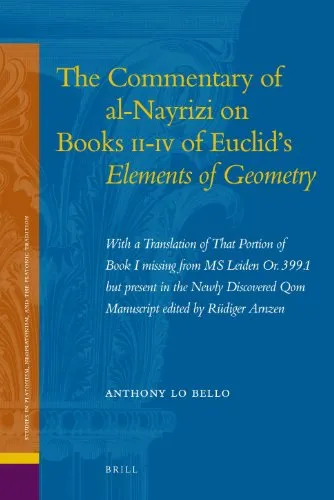
The Commentary of al-Nayrizi on Books II-IV of Euclid's Elements of Geometry
Anthony Lo Bello
2009
View book