Book guide and evaluation
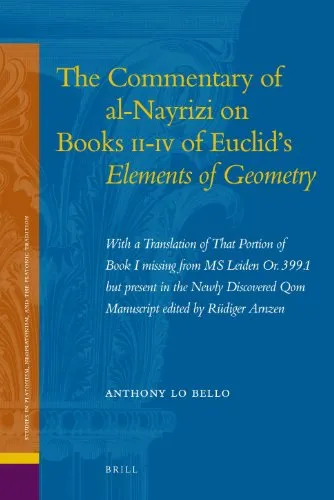
The Commentary of al-Nayrizi on Books II-IV of Euclid's Elements of Geometry
Anthony Lo Bello
English
Beginner
Mathematics
4.8 / 5
0 reviews
2009
Published
249
pages
446
views
''The Commentary of al-Nayrizi (circa 920) on Euclid's Elements of Geometry'' occupies an important place both in the history of mathematics and of philosophy, particularly Islamic philosophy. It is a compilation of original work by al-Nayrizi and of translations and commentaries
Before you read
What will you get from this book?
''The Commentary of al-Nayrizi (circa 920) on Euclid's Elements of Geometry'' occupies an important place both in the history of mathematics and of philosophy, particularly Islamic philosophy. It is a compilation of original work by al-Nayrizi and of translations and commentaries made by others, such as Heron. It is the most influential Arabic mathematical manuscript in existence and a principle vehicle whereby mathematics was reborn in the Latin West. Furthermore, the Commentary on Euclid by the Platonic philosopher Simplicius, entirely reproduced by al-Nayrizi, and nowhere else extant, is essential to the study of the attempt to prove Euclid's Fifth Postulate from the preceding four. ''Al-Nayrizi'' was one of the two main sources from which Albertus Magnus (1193-1280), the Doctor Universalis, learned mathematics. This work presents an annotated English translation of Books II-IV and of a hitherto lost portion of Book I
Ask this book
Your question is answered in the context of this title and author. Each answer uses 2 points.
Sign in to ask the book assistant.
Reader reviews
0 reviews, 4.8 average out of 5
No reviews yet
If you have read this book, help the next reader with your experience.
Write a review
Sign in to publish a review.
Reader questions and answers
Ask a focused question and learn from the community.
Sign in to ask or answer a question.
No questions yet
Be the first to ask a clear, useful question.
What to read next
Related references that continue this learning path.
Robert of Chester’s (?) Redaction of Euclid’s Elements, the so-called Adelard II Version: Volume II
Dr. Hubert L. L. Busard,Prof. Dr. Menso Folkerts (auth.)
1992
View book