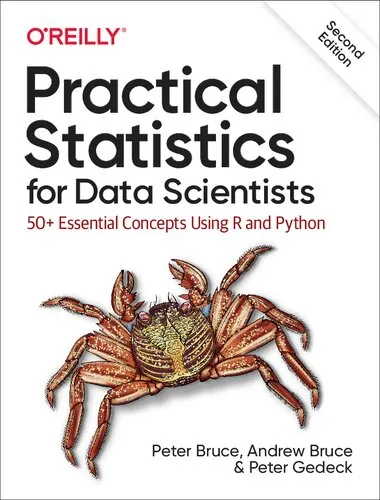
Practical Statistics for Data Scientists: 50+ Essential Concepts Using R and Python
Peter Bruce,Andrew Bruce,Peter Gedeck
2020
View book
Book guide and evaluation
Grinstead C.M.,Snell J.L.
0 reviews
Published
pages
views
Introduction to "Introduction to Probability - Answers" Probability is the cornerstone of modern science and statistics. It has applications across fields as diverse as finance, engineering, medicine, artificial intelligence, and even everyday decision-making. The book "Introd
Before you read
Probability is the cornerstone of modern science and statistics. It has applications across fields as diverse as finance, engineering, medicine, artificial intelligence, and even everyday decision-making. The book "Introduction to Probability - Answers" serves as a comprehensive companion to "Introduction to Probability," addressing solutions to exercises and providing detailed insights into the workings of probability theory. This introduction guides readers through the purpose of the book, its notable features, and its invaluable contributions to understanding probability.
Written by Charles M. Grinstead and J. Laurie Snell, "Introduction to Probability - Answers" is designed to supplement the core textbook "Introduction to Probability." This book provides step-by-step solutions to the exercises presented in the original textbook, fostering a deeper comprehension of key concepts. Covering fundamental topics such as combinatorics, conditional probabilities, random variables, the Central Limit Theorem, Markov Chains, and advanced probability distributions, the solutions are structured to encourage active learning.
The complexity of probability can sometimes leave students feeling overwhelmed. The authors alleviate this by presenting each solution with precision and clarity. These solutions are annotated to highlight the key techniques and methods employed, ensuring that readers not only solve problems but also understand the reasoning behind them.
Designed for both students and instructors, this book is an invaluable tool for reinforcing knowledge, preparing for exams, and mastering the art of mathematical reasoning. Its structured approach builds from the basics, gradually immersing readers in more challenging problems without losing sight of the core principles.
“Probability is the bridge between pure mathematics and the uncertainties of the real world.”
“The future depends on understanding the likelihood of outcomes, not just the outcomes themselves.”
“Every problem in probability offers a chance to think logically about uncertainty.”
As probability increasingly underpins the logic of modern science, "Introduction to Probability - Answers" equips readers with a deeper understanding of this essential field. By addressing every exercise with meticulous detail, the book serves as a guide to not just solving problems but learning problem-solving. This distinction makes it more than just an answer key—it is a pedagogical tool that fosters intuition and creative thinking.
For instructors, the book simplifies the task of assisting students in fully grasping difficult concepts. For learners, it ensures that they can independently verify their work and dissect complex problems with confidence. These attributes are what make this book a quintessential resource for anyone studying or teaching probability.
Moreover, probability is crucial for understanding an increasingly data-driven world. From predicting weather patterns to improving business analytics, the methods taught in this book are widely applicable. As artificial intelligence and machine learning rise in prominence, the value of understanding probability deepens. This book exemplifies how foundational knowledge can lead to mastering advanced computational systems and probabilistic models.
Your question is answered in the context of this title and author. Each answer uses 2 points.
0 reviews, 4.5 average out of 5
Sign in to publish a review.
Ask a focused question and learn from the community.
Related references that continue this learning path.
Peter Bruce,Andrew Bruce,Peter Gedeck