
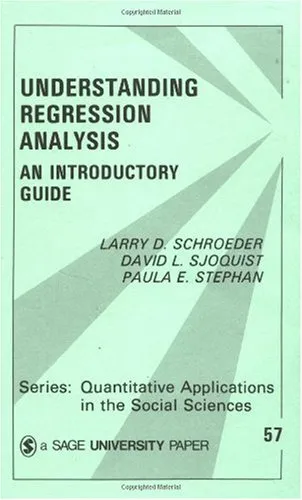
Understanding Regression Analysis: An Introductory Guide
Larry Schroeder,Dr. David L. Sjoquist,Dr. Paula E. Stephan
1986
View book

Book guide and evaluation
Christophe Giraud
0 reviews
Published
pages
views
Introduction to High-Dimensional Statistics High-dimensional statistics is an exciting and rapidly growing field of study, driven by the exponential increase in the complexity and size of datasets in modern applications. My book, Introduction to High-Dimensiona
Before you read
High-dimensional statistics is an exciting and rapidly growing field of study, driven by the exponential increase in the complexity and size of datasets in modern applications. My book, Introduction to High-Dimensional Statistics, is designed to provide a systematic, accessible, and rigorous overview of the fundamental concepts, methodologies, and tools required for success in this domain. This book serves as a foundational guide for statisticians, data scientists, researchers, and academics who aim to understand, analyze, and solve high-dimensional problems efficiently.
High-dimensional data analysis is no longer a niche field—in today’s data-driven world, datasets with more variables than observations are commonplace. From genomics and neuroscience to finance and machine learning, we routinely encounter data with complex dependencies and sparse structures. My book provides a structured introduction to the basic mathematical frameworks, statistical tools, and algorithmic techniques essential for navigating such challenges.
The book begins with a gentle introduction to the statistical foundations such as probabilistic modeling, sparsity, and regularization techniques. It then delves into high-dimensional linear regression methods, exploring key concepts like the LASSO, Ridge regression, and elastic net, with a focus on their applications in sparsity contexts. Additionally, chapters discuss principal component analysis (PCA), covariance estimation, and graphical models for handling dependencies and dimensions.
Later sections delve deeper into theoretical guarantees, providing insight into algorithmic efficiency, error rates, and convergence in high-dimensional settings. I also explore high-dimensional hypothesis testing and variable selection, connecting theoretical underpinnings with practical implementations. Each chapter is developed with numerous examples, detailed proofs, and exercises to ensure an applied understanding of the material.
“In high-dimensional settings, statistical intuition must be augmented by a keen understanding of sparsity, computational efficiency, and theoretical guarantees.”
“The curse of dimensionality is not just a mathematical challenge—it reshapes how we extract meaningful insights from data.”
“Regularization is the art of enforcing simplicity in models, allowing us to paint clearer statistical pictures in complex, noisy worlds.”
In today’s data-driven age, the scale and complexity of datasets have outpaced traditional inferential and computational techniques. High-dimensional statistics offers a vital toolkit for making sense of these datasets. This book is particularly critical for those who wish to transition from conventional statistical methods to modern contexts involving big data, machine learning, and artificial intelligence.
What makes Introduction to High-Dimensional Statistics stand out is its balance of theoretical rigor and practical application. It bridges the gap between abstract statistical theory and hands-on techniques, empowering readers with both knowledge and tools to solve high-dimensional challenges. Whether you are a graduate student, researcher, or practitioner, this book will equip you with badly needed skills for remaining relevant in an ever-evolving data landscape.
Moreover, the careful integration of theoretical insights and applied methodologies ensures a clear and coherent learning curve, suitable for self-study and classroom contexts alike. With its emphasis on intuition, practicality, and technical precision, this book should be a cornerstone in the library of anyone involved in data science and statistics.
Your question is answered in the context of this title and author. Each answer uses 2 points.
0 reviews, 4.5 average out of 5
Sign in to publish a review.
Ask a focused question and learn from the community.
Related references that continue this learning path.
Larry Schroeder,Dr. David L. Sjoquist,Dr. Paula E. Stephan

Robert Bartoszynski,Magdalena Niewiadomska-Bugaj