
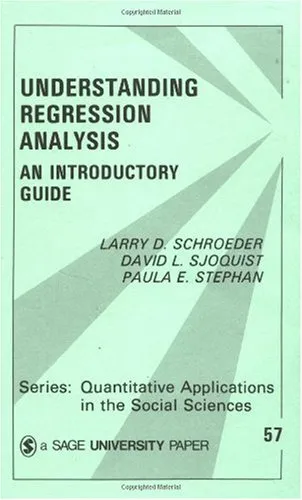
Understanding Regression Analysis: An Introductory Guide
Larry Schroeder,Dr. David L. Sjoquist,Dr. Paula E. Stephan
1986
View book

Book guide and evaluation
Seymour Geisser,Wesley M. Johnson
0 reviews
Published
pages
views
Introduction to "Modes of Parametric Statistical Inference" "Modes of Parametric Statistical Inference," written by Seymour Geisser and Wesley M. Johnson, is a groundbreaking text that delves into the foundations, principles, and methodologies of parametric statist
Before you read
"Modes of Parametric Statistical Inference," written by Seymour Geisser and Wesley M. Johnson, is a groundbreaking text that delves into the foundations, principles, and methodologies of parametric statistical inference. This book is designed to challenge the traditional perspectives of statistical inference by exploring alternative paradigms and offering a deeper understanding of the underlying principles. It caters to statisticians, researchers, and students who seek to gain a thorough grasp of how parametric inference operates, its theoretical underpinnings, and its practical applications across diverse scientific contexts.
The central theme of the book focuses on the ways in which statistical inferences can be derived under parametric assumptions, exploring various modes of thought such as Bayesian inference, likelihood-based perspectives, and frequentist approaches. Through its clear explanations, extensive examples, and insightful discussions, "Modes of Parametric Statistical Inference" provides readers with a powerful framework for analyzing statistical data while considering both theoretical relevance and real-world applicability.
The book is meticulously structured to explore distinct modes of parametric statistical inference in great depth. It begins by presenting the basic principles of parametric models, illustrating their role in simplifying complex data structures while maintaining interpretive power. Building on this foundation, the authors examine different approaches to statistical inference, such as likelihood-based methods, Bayesian frameworks, and nonparametric considerations.
One of the book's core contributions is its emphasis on the complementary rather than conflicting nature of different inferential modes. By discussing the advantages and limitations of each perspective, the authors highlight how combining methodologies can yield a more robust and comprehensive understanding of data. The interplay between frequentist and Bayesian philosophies is particularly illuminating, as the authors challenge traditional divides and advocate for flexibility in statistical reasoning.
Practical examples and exercises are seamlessly integrated into the narrative, allowing readers to apply theoretical concepts to real-world problems. Topics covered include hypothesis testing, interval estimation, model selection, and predictive inference, among others. The book concludes with a thought-provoking discussion on the philosophical and practical implications of different inferential frameworks, equipping readers with the tools to make informed choices in their statistical practices.
"Statistical inference is not a rigid algorithm, but rather an art of balancing precision, prediction, and philosophical coherence."
"By understanding the interconnections between inferential modes, one gains not only flexibility but also deeper insights into the data itself."
"Modes of Parametric Statistical Inference" plays an essential role in demystifying the complex yet fascinating realm of statistical inference. It fills a critical gap in the literature by demonstrating how differing inferential paradigms can coexist, guide decision-making, and improve real-world outcomes. For statisticians, this book provides clarity and flexibility, enabling them to tailor approaches based on problem-specific needs.
Beyond its academic value, the book makes a compelling case for reevaluating the rigid dichotomy between frequentism and Bayesianism in modern statistics. By encouraging readers to adopt a pluralistic perspective, Geisser and Johnson help foster innovation and creativity in statistical research and practice. Whether you're a practitioner, an academician, or a student of statistics, this text is an invaluable resource for mastering the art of parametric inference.
Your question is answered in the context of this title and author. Each answer uses 2 points.
0 reviews, 4.0 average out of 5
Sign in to publish a review.
Ask a focused question and learn from the community.
Related references that continue this learning path.
Larry Schroeder,Dr. David L. Sjoquist,Dr. Paula E. Stephan
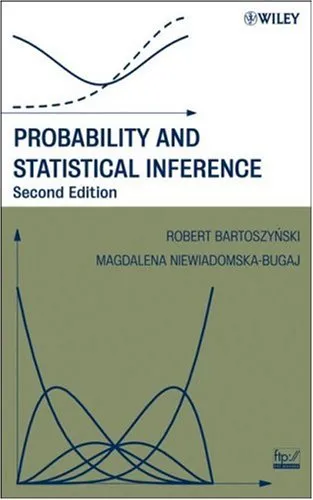
Robert Bartoszynski,Magdalena Niewiadomska-Bugaj

Calyampudi Radhakrishna. Rao,C.Radhakrishna Rao