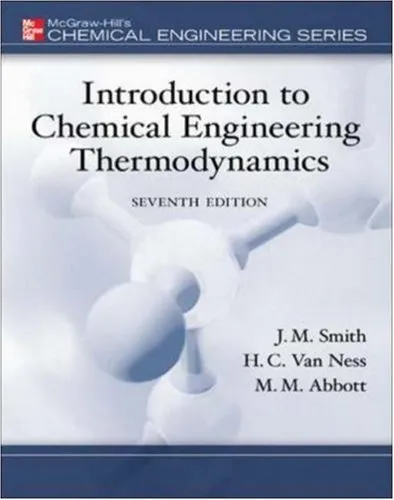
solution manual Introduction to Chemical Engineering Thermodynamics 7th Edition
J.M. Smith,Hendrick Van Ness,Michael Abbott
2004
View book
Book guide and evaluation
Joseph M. Smith,H. C. Van Ness
0 reviews
Published
pages
views
Introduction to Chemical Engineering Thermodynamics Authored by Joseph M. Smith and H. C. Van Ness, "Introduction to Chemical Engineering Thermodynamics" stands as a foundational text that has shaped the landscape of chemical engineering education and practice. Its comprehensi
Before you read
Authored by Joseph M. Smith and H. C. Van Ness, "Introduction to Chemical Engineering Thermodynamics" stands as a foundational text that has shaped the landscape of chemical engineering education and practice. Its comprehensive approach and rigorous examination equip engineers with the principles needed to excel in the field of thermodynamics.
The book "Introduction to Chemical Engineering Thermodynamics" meticulously delves into the principles and applications of thermodynamics in chemical engineering. It starts by laying out the fundamental concepts of energy conservation, thermodynamic laws, and properties of matter, which establish the groundwork for comprehending more complex phenomena. The integration of theory with practical application is a hallmark of this book, ensuring that readers not only learn the conceptual framework but also understand how to apply it in real-world scenarios.
Throughout its chapters, the text covers a broad spectrum of topics, including the behavior of gases and liquids, vapor-liquid equilibrium, chemical reaction equilibria, and the thermodynamic properties of mixtures. It emphasizes mathematical modeling and the use of modern tools to address complex systems, making it increasingly relevant in today’s technology-driven world. Advanced topics such as phase equilibrium and the roles of entropy and enthalpy are discussed with clarity, guided by illustrative examples and problem sets that challenge and enhance the reader's understanding.
"In the vast landscape of engineering, thermodynamics stands as a pivotal pillar, ensuring that the principles of energy and matter are comprehensively understood."
"The elegance of thermodynamics lay not only in its laws but in its ability to quantify the seemingly intangible interactions of energy and matter."
"Introduction to Chemical Engineering Thermodynamics" remains a critical resource for any student or professional in the field of chemical engineering. Its value goes beyond mere academic instruction; it serves as a bridge between basic theory and the complexities of modern engineering challenges. The book's thoroughness and commitment to intertwining the foundational precepts of thermodynamics with cutting-edge applications ensure its continued relevance.
Moreover, the textbook’s expansion into modern issues reflects the changes and advances within the industry, making it an indispensable tool for both new learners and seasoned engineers. Its methodical approach allows learners to build a solid understanding that can be adapted to any future challenges they may face as technology and industry needs evolve.
The continued success and adoption of this book are a testament to its crucial role in shaping thermodynamic education and its ability to prepare engineers for the demands of their profession. Its emphasis on a clear, precise conveyance of ideas sets it apart as a must-read for those aspiring to contribute meaningfully to the field of chemical engineering.
Your question is answered in the context of this title and author. Each answer uses 2 points.
0 reviews, 4.7 average out of 5
Sign in to publish a review.
Ask a focused question and learn from the community.
Related references that continue this learning path.
J.M. Smith,Hendrick Van Ness,Michael Abbott