Solutions Manual for Thermodynamics: An Engineering Approach 9th Edition in SI Units
Yunus A. Cengel,Michael A. Boles Boles,Mehmet Kanogiu
2019
View book
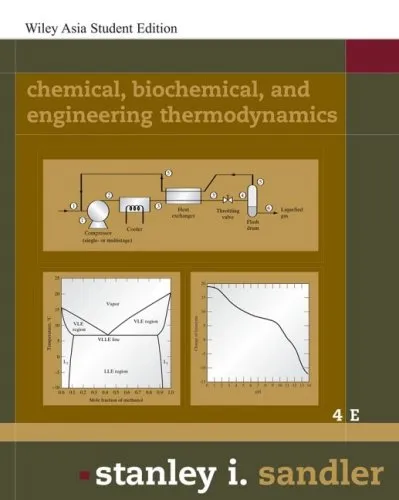
Book guide and evaluation
Stanley I. Sandler
0 reviews
Published
pages
views
Introduction to 'Chemical, Biochemical, and Engineering Thermodynamics' Welcome to the comprehensive guide on the principles of thermodynamics tailored for students and professionals in the fields of chemical, biochemical, and engineering disciplines. 'Chemical, Biochemica
Before you read
Welcome to the comprehensive guide on the principles of thermodynamics tailored for students and professionals in the fields of chemical, biochemical, and engineering disciplines. 'Chemical, Biochemical, and Engineering Thermodynamics' by Stanley I. Sandler has been a pivotal resource in understanding the intricacies of thermodynamics, providing a blend of theoretical insights and practical applications.
This book offers an in-depth exploration of thermodynamic principles, with a unique focus on applications within chemical and biochemical engineering. It balances theoretical foundation with applied knowledge, guiding the reader from fundamental concepts to the complexities of real-world applications. The book includes sections on statistical mechanics, equilibrium statistics, and the properties of pure substances, all embedded in the context of chemical and biochemical processes.
Furthermore, the book presents advanced topics such as non-ideal solutions, phase equilibria, chemical reaction equilibria, and thermodynamics of polymers and surfaces. Each section is meticulously structured to offer both clarity and depth, ensuring that the reader gains a comprehensive understanding. Problem-solving is emphasized throughout, with illustrative examples and end-of-chapter problems to reinforce learning.
"Thermodynamics is not the art of guessing equations; it is the disciplined method of deciphering the laws of nature."
"In understanding thermodynamics, one must realize that equations and data are but the servants of the true purpose: understanding the limitations nature imposes on processes."
'Chemical, Biochemical, and Engineering Thermodynamics' is more than a textbook; it is a pivotal tool for developing a profound understanding of thermodynamics in the context of engineering applications. This book is indispensable for students and professionals who aspire to innovate and excel in the chemical and biochemical industries. It bridges the gap between theoretical constructs and practical applications, enhancing the reader’s ability to tackle complex problems with confidence and creativity.
By offering clarity and depth, the book equips readers with the necessary skills to not only grasp fundamental principles but also apply them to solve novel engineering challenges. Additionally, its structured approach makes it an excellent resource for self-study and reference, distinguishing it as a critical asset in any scientific library.
Your question is answered in the context of this title and author. Each answer uses 2 points.
0 reviews, 4.6 average out of 5
Sign in to publish a review.
Ask a focused question and learn from the community.
Related references that continue this learning path.
Yunus A. Cengel,Michael A. Boles Boles,Mehmet Kanogiu
J.M. Smith,Hendrick Van Ness,Michael Abbott