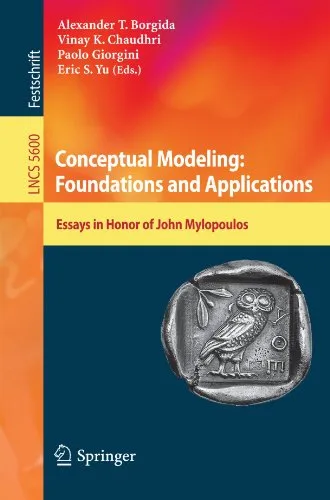
Conceptual Modeling: Foundations and Applications: Essays in Honor of John Mylopoulos
Michael L. Brodie (auth.),Alexander T. Borgida,Vinay K. Chaudhri,Paolo Giorgini,Eric S. Yu (eds.)
2009
View book
Book guide and evaluation
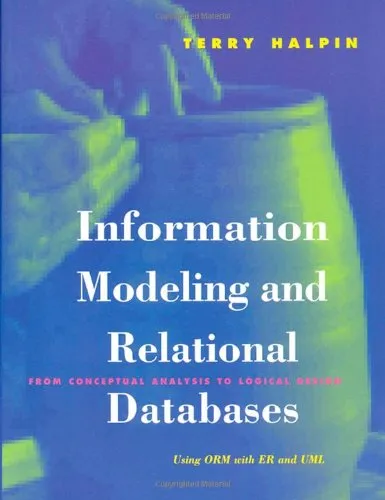
Terry Halpin
0 reviews
Published
pages
views
Welcome to the enriching universe of data management and information systems with "Information Modeling and Relational Databases: From Conceptual Analysis to Logical Design" authored by Terry Halpin. This book is a cornerstone for anyone navigating the complex terrain of databa
Before you read
Welcome to the enriching universe of data management and information systems with "Information Modeling and Relational Databases: From Conceptual Analysis to Logical Design" authored by Terry Halpin. This book is a cornerstone for anyone navigating the complex terrain of database systems, offering a thorough guide from the initial stages of modeling information to its implementation in relational databases.
This comprehensive text is designed to bridge the gap between the theoretical aspects of information modeling and their practical application in relational database systems. The book is structured to take readers through a journey starting with conceptual analysis, where the foundation of data modeling begins through Object-Role Modeling (ORM). ORM is explored in depth as a rigorous approach to conceptual schema design. The text transitions into logical design, focusing on how these conceptual models are translated into relational models. Throughout its chapters, this book introduces essential database concepts, including integrity constraints, derivation rules, and transformations.
Each chapter builds incrementally to cover complex topics like normalization and denormalization, Object-Relational mapping, and the expressive power of constraints within relational databases. Readers will appreciate the well-integrated case studies and examples from real-world scenarios that reinforce the application of these principles. Furthermore, the inclusion of exercises and review questions helps to consolidate the reader's understanding of the material.
The book is crafted to make it a comprehensive resource not only for novices but also for experienced database professionals seeking to refresh their knowledge:
"Understanding the true nature of information structures is essential for creating effective database models."
"The journey from a conceptual framework to a relational schema is one of the most critical routes in the landscape of information technology."
In a rapidly evolving digital world, "Information Modeling and Relational Databases" serves as a vital guide for practitioners, academics, and students who aim to deeply understand and master the art of data modeling. The book's importance lies in its comprehensive approach, blending theoretical insights with practical application. It equips readers with the skills necessary to design high-quality, robust databases that meet the demands of modern applications.
Moreover, the book's focus on Object-Role Modeling as the preferred method for conceptual design sets it apart, offering a unique advantage in representing complex data interactions more naturally compared to traditional methods. As organizations face growing data complexities, understanding how to model and manage this information efficiently is paramount, making this book an essential addition to any tech professional’s library.
Your question is answered in the context of this title and author. Each answer uses 2 points.
0 reviews, 4.5 average out of 5
Sign in to publish a review.
Ask a focused question and learn from the community.
Related references that continue this learning path.
Michael L. Brodie (auth.),Alexander T. Borgida,Vinay K. Chaudhri,Paolo Giorgini,Eric S. Yu (eds.)