Book guide and evaluation
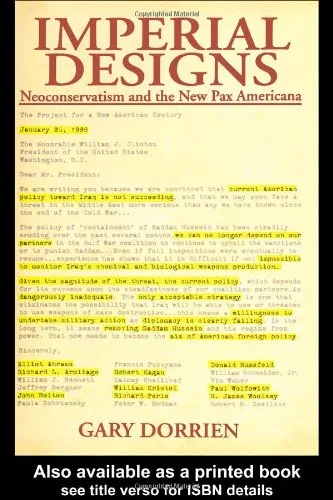
Imperial Designs: Neoconservatism and the New Pax Americana
Gary Dorrien
English
Advanced
Art
4.3 / 5
0 reviews
2004
Published
299
pages
340
views
Imperial Designs: Neoconservatism and the New Pax Americana U.S. foreign policy, American imperialism Imperial Designs: Neoconservatism and the New Pax Americana explores modern U.S. foreign policy through the lens of neoconservative ideology. Analytical Summary I
Before you read
What will you get from this book?
Analytical Summary
Imperial Designs: Neoconservatism and the New Pax Americana offers a deep and critical examination of the ideological currents that shaped U.S. foreign policy in the late twentieth and early twenty-first centuries. Written with scholarly rigor, the book dissects the intellectual and political trajectory of neoconservatism, tracing its origins, philosophical underpinnings, and its profound influence on what some describe as a new “Pax Americana.”
This work carefully charts the interplay between political theory and pragmatic policy decisions, illustrating how a set of ideas developed in think tanks and academic circles eventually became hallmarks of global strategy under certain administrations. The analysis highlights not only the doctrinal components of neoconservatism but also its manifestation in military interventions, diplomatic initiatives, and approaches to international law.
In studying this nexus of ideology and action, Imperial Designs: Neoconservatism and the New Pax Americana situates key events—such as the post-Cold War redefinition of U.S. engagement abroad—in the broader context of American imperialism. It is a text that rewards close reading for scholars, policy analysts, and anyone seeking to understand the inner logic of a controversial and highly consequential worldview.
Key Takeaways
The book distills complex political philosophies into accessible narratives without sacrificing depth, allowing readers to grasp the essentials of neoconservative thought and its geopolitical ramifications.
It identifies the historical roots of neoconservatism in Cold War liberalism and anticommunism, revealing how these foundations evolved into a proactive defense of American global leadership.
It underscores the strategic emphasis on military strength, democracy promotion, and moral clarity as guiding principles for foreign policy, while candidly addressing criticisms of imperial overreach.
Through case studies, the book examines policy shifts during pivotal moments, offering readers a clear understanding of cause-and-effect relationships in international affairs.
Memorable Quotes
"Ideas have consequences, especially when they are wielded as instruments of statecraft." Unknown
"Neoconservatism thrives on the belief that American power is a force for good in the world." Unknown
"The New Pax Americana is not a passive peace; it is actively constructed and vigilantly defended." Unknown
Why This Book Matters
For students of international relations, political science, history, and American studies, Imperial Designs: Neoconservatism and the New Pax Americana serves as a central resource in decoding one of the most influential currents in U.S. policymaking over recent decades.
This book contributes to academic and professional discourse by presenting a balanced critique—acknowledging neoconservatism’s intellectual strengths while documenting its policy vulnerabilities. It enables readers to trace how ideology intersects with state interests, producing both intended and unintended outcomes on the world stage.
Information unavailable regarding specific awards or honors for the book; no reliable public source confirms such distinctions. Nonetheless, its analytical depth and relevance have secured its place in scholarly libraries and among policy experts.
Inspiring Conclusion
Imperial Designs: Neoconservatism and the New Pax Americana is more than a historical account—it is a clarion call to engage with the ideas shaping the future of global order.
By weaving together intellectual history and policy analysis, it invites readers to critically examine the forces that have propelled the United States into its role as a dominant global actor. The book’s compelling insights into neoconservatism and American imperialism make it a vital touchstone for informed debate.
Readers, academics, and professionals alike are encouraged to read, share, and discuss the arguments contained within Imperial Designs: Neoconservatism and the New Pax Americana, fostering a more nuanced and thoughtful engagement with the pressing challenges of our time.
Ask this book
Your question is answered in the context of this title and author. Each answer uses 2 points.
Sign in to ask the book assistant.
Reader reviews
0 reviews, 4.3 average out of 5
No reviews yet
If you have read this book, help the next reader with your experience.
Write a review
Sign in to publish a review.
Reader questions and answers
Ask a focused question and learn from the community.
Sign in to ask or answer a question.
No questions yet
Be the first to ask a clear, useful question.
What to read next
Related references that continue this learning path.