Book guide and evaluation
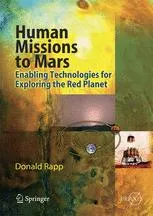
Human Missions to Mars: Enabling Technologies for Exploring the Red Planet
Dr Donald Rapp (auth.)
English
Intermediate
novel
4.7 / 5
0 reviews
2007
Published
543
pages
446
views
In “Human Missions to Mars” Donald Rapp looks at human missions to Mars from an engineering perspective. He begins by describing the pros and cons of robotic exploration versus human exploration and then examines the ideas for sending humans to Mars from the point of view of both
Before you read
What will you get from this book?
In “Human Missions to Mars” Donald Rapp looks at human missions to Mars from an engineering perspective. He begins by describing the pros and cons of robotic exploration versus human exploration and then examines the ideas for sending humans to Mars from the point of view of both the enthusiast and the skeptic. Chapter 2 describes how space missions are planned and how they may be achieved as a sequence of separate steps. Chapter 3 deals with the complex issues relating to the outward journey to Mars and the return leg. The author deals with propulsion systems and with the analysis of the various trajectories which may be utilized for such a mission. He divides mission into a number of stages: Earth’s surface to low-Earth orbit (LEO); departing from LEO; Mars orbit insertion and landing; ascent from Mars; trans-Earth injection from Mars orbit and Earth orbit insertion and landing. Chapter 4 discusses a wide range of elements critical to a human Mars mission, including life support consumables, radiation effects and shielding, microgravity effects, abort options and mission safety, possible habitats on the Martian surface and aero assisted orbit insertion and entry decent and landing. For any human mission to the Red Planet the possible utilization of any resources indigenous to Mars would be of great value and such possibilities are discussed in Chapter 5. The use of indigenous resources on the Moon is described as a precursor to the availability of similar resources on Mars and issues such as fuelling Mars-bound craft from lunar resources, the use of lunar ferries, staging, assembly and refueling in near-Earth space are all discussed. The important applications arising from the transportation of hydrogen to Mars are also described. Chapter 6 deals with a range of previous Mars mission studies and the technologies they employed. Chapter 7 looks as how NASA is planning for its return to the Moon, and the use of the Moon as a stepping stone to Mars. Chapter 8 presents the author’s detailed analysis of why, in his opinion, the current NASA approach will fail to send humans to Mars before 2080. The book concludes with three appendices describing the use of solar energy on the Moon and on Mars and the value of indigenous water on Mars.
Ask this book
Your question is answered in the context of this title and author. Each answer uses 2 points.
Sign in to ask the book assistant.
Reader reviews
0 reviews, 4.7 average out of 5
No reviews yet
If you have read this book, help the next reader with your experience.
Write a review
Sign in to publish a review.
Reader questions and answers
Ask a focused question and learn from the community.
Sign in to ask or answer a question.
No questions yet
Be the first to ask a clear, useful question.
What to read next
Related references that continue this learning path.
Exploring the Martian Moons: A Human Mission to Deimos and Phobos
Manfred “Dutch” von Ehrenfried (auth.)
2017
View book

Crossing the Line: Violence, Play, and Drama in Naval Equator Traditions
Simon J. Bronner
2007
View book