![Cover of Combinatorics 1: The art of counting [Lecture notes]](https://s3.refhub.ir/images/thumb/Combinatorics_1__The_art_of_counting__Lecture_15529.webp)
Book guide and evaluation
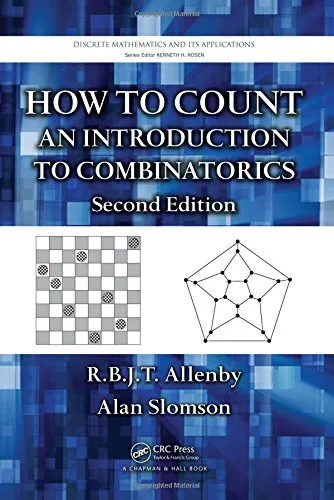
How to Count: An Introduction to Combinatorics, Second Edition
R.B.J.T. Allenby,Alan Slomson
English
Beginner
Mathematic Combinatorics
4.7 / 5
0 reviews
2010
Published
440
pages
519
views
Welcome to the intricate and fascinating world of combinatorics, where counting becomes not only an essential skill but an intellectually stimulating adventure. "How to Count: An Introduction to Combinatorics, Second Edition" by R.B.J.T. Allenby and Alan Slomson stands as an
Before you read
What will you get from this book?
Welcome to the intricate and fascinating world of combinatorics, where counting becomes not only an essential skill but an intellectually stimulating adventure. "How to Count: An Introduction to Combinatorics, Second Edition" by R.B.J.T. Allenby and Alan Slomson stands as an essential guide for those eager to explore the mathematical art of counting.
Detailed Summary of the Book
Combinatorics, often dubbed the science of counting, is a cornerstone of modern mathematics, applicable across statistics, computer science, and logic. This text serves as an accessible yet comprehensive introduction to the subject, designed to build a robust foundation for students and enthusiasts alike. The authors meticulously traverse through fundamental concepts, starting from permutations and combinations, and progressing to cover more advanced topics like the pigeonhole principle, inclusion-exclusion principle, and generating functions.
One of the book’s hallmarks is its user-friendly approach. Complex ideas are systematically broken down into comprehensible segments, befitting both beginners and those needing a refresher. The second edition enriches the content further with additional examples and exercises, enabling learners to practice and internalize key concepts. Important connections with other mathematical areas are highlighted, showcasing combinatorics' pivotal role in the broader scientific field.
Key Takeaways
- Understand fundamental combinatorial principles like permutations, combinations, and the binomial theorem.
- Gain insights into advanced counting methods such as the pigeonhole principle and inclusion-exclusion principle.
- Learn how to apply combinatorial reasoning to solve real-world problems in statistics, computer science, and beyond.
- Develop analytical skills and logical thinking, crucial for advancing in mathematical studies and research.
Famous Quotes from the Book
"Combinatorics is at the heart of many basic concepts in mathematics, forming the backdrop of more complex mathematical spaces."
"The elegance of combinatorics lies not just in counting but in understanding the structures behind the numbers."
Why This Book Matters
In an era where data analytics and computer science reign supreme, a deep understanding of combinatorics is invaluable. This book demystifies the intricacies of counting techniques, providing a vital toolkit for anyone pursuing mathematics, engineering, or technology careers. Beyond its practical importance, this text fosters a greater appreciation for the beauty of combinatorial reasoning, inspiring learners to delve deeper into the mathematical universe.
Its structured pedagogy, replete with examples and exercises, makes it an eminently teachable resource fit for classroom settings or self-study. The authors' clear style and comprehensive coverage ensure that readers not only learn how to count but understand why counting is at the core of so many mathematical explorations.
Ask this book
Your question is answered in the context of this title and author. Each answer uses 2 points.
Sign in to ask the book assistant.
Reader reviews
0 reviews, 4.7 average out of 5
No reviews yet
If you have read this book, help the next reader with your experience.
Write a review
Sign in to publish a review.
Reader questions and answers
Ask a focused question and learn from the community.
Sign in to ask or answer a question.
No questions yet
Be the first to ask a clear, useful question.
What to read next
Related references that continue this learning path.
A First Course in Graph Theory and Combinatorics: Second Edition (Texts and Readings in Mathematics, 55)
Sebastian M. Cioabă,M. Ram Murty
2022
View book