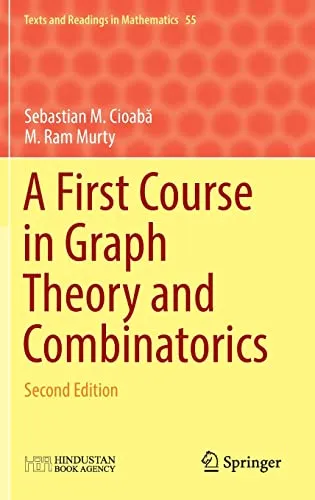
A First Course in Graph Theory and Combinatorics: Second Edition (Texts and Readings in Mathematics, 55)
Sebastian M. Cioabă,M. Ram Murty
2022
View book
Book guide and evaluation
Baela Bajnok
0 reviews
Published
pages
views
Introduction Welcome to the world of Additive Combinatorics, a vibrant and flourishing field of study that dances gracefully at the intersection of mathematics and its applications. "Additive Combinatorics: A Menu of Research Problems" serves as bot
Before you read
Welcome to the world of Additive Combinatorics, a vibrant and flourishing field of study that dances gracefully at the intersection of mathematics and its applications. "Additive Combinatorics: A Menu of Research Problems" serves as both a visionary beacon and an exploratory guide for students, researchers, and enthusiasts eager to dive into this compelling domain. While mathematics can often appear daunting with its labyrinth of theorems and proofs, this book aims to break down complex topics into approachable challenges, presenting them in the form of research problems that stimulate curiosity and foster analytical thinking.
Additive Combinatorics: A Menu of Research Problems unfolds over several meticulously crafted chapters designed to engage readers with questions and themes central to the field of additive combinatorics. This approach underscores the book’s unique pedagogical framework: a problem-based learning strategy that emphasizes inquiry and discovery. Each chapter is carefully structured, beginning with foundational theory before progressing to nuanced problems that challenge readers to develop and apply their understanding.
Chapters delve into a plethora of topics fundamental to additive combinatorics. These include sumsets, the intricacies of combinatorial geometry, and elaborative discussions on approximation algorithms. The book further explores advanced subjects such as the probabilistic method, Fourier analysis on groups, and ergodic theory applications. By cultivating a narrative that both questions and informs, the book empowers readers to not only absorb established knowledge but also contribute novel insights to the field.
"Additive combinatorics allows us to reconstruct the melodies of numbers, where every addition forms a new cadence in the grand symphony of mathematics."
"Every problem we pose is akin to a locked door; mathematics hands us the keys of logic, curiosity, and perseverance."
Mathematics has always been more than a field of study; it is a philosophy, a language, and a tool that unlocks the secrets of the universe. Additive Combinatorics: A Menu of Research Problems offers readers a unique opportunity to engage with this philosophy directly. It is invaluable for fostering a deeper understanding of not only additive combinatorics but also the broader implications of combinatorial methods in various scientific disciplines.
This book stands out by providing a practical approach to theory, aiming to cultivate the next generation of mathematicians who are thinkers and doers. By presenting research as an exciting field-wide exploration, it prepares readers to make meaningful contributions and encourages them to see the beauty in questions yet unanswered. This makes "Additive Combinatorics: A Menu of Research Problems" a crucial addition to any mathematical library, inspiring all who peruse its pages to view problems as starting points rather than obstacles.
Your question is answered in the context of this title and author. Each answer uses 2 points.
0 reviews, 4.9 average out of 5
Sign in to publish a review.
Ask a focused question and learn from the community.
Related references that continue this learning path.
Sebastian M. Cioabă,M. Ram Murty