Book guide and evaluation
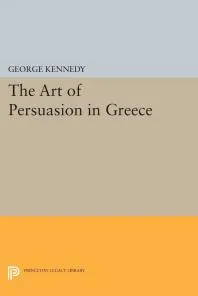
History of Rhetoric, Volume I : The Art of Persuasion in Greece
George A. Kennedy
English
Advanced
Art
4.6 / 5
0 reviews
1963
Published
362
pages
398
views
History of Rhetoric, Volume I : The Art of Persuasion in Greece Ancient Greek rhetoric, classical persuasion strategies Explore History of Rhetoric, Volume I : The Art of Persuasion in Greece, a profound study of classical persuasion and its enduring impact. Analytic
Before you read
What will you get from this book?
Analytical Summary
History of Rhetoric, Volume I : The Art of Persuasion in Greece offers a rigorous examination of rhetorical theory and practice in Ancient Greece, tracing its evolution from the earliest sophistic movements through the disciplined frameworks articulated by Aristotle. It stands as an authoritative resource for scholars, educators, and professionals seeking to understand how language and logic shaped democratic discourse, philosophical argumentation, and legal advocacy during the formative centuries of Western thought.
The book introduces readers to key figures such as the Sophists, Isocrates, Plato, and Aristotle, positioning their contributions within the larger social and political currents of the Greek world. Through detailed textual analysis and historical context, it reveals how rhetorical techniques were employed not only in formal speeches but also in everyday civic life, influencing decision-making at all levels.
Each chapter delineates a specific phase in the development of Greek rhetoric, carefully parsing the transition from oral traditions to more formalized systems of persuasion. The work also pays close attention to ethical considerations, exploring debates over the legitimacy of persuasion when divorced from truth — an issue as relevant today as it was in classical debates.
Key Takeaways
Readers will emerge with a nuanced understanding of rhetorical origins and their lasting legacy in the modern world. This is not merely an academic chronicle; it is a lens through which the mechanics of influence can be examined and appreciated.
First, the text demonstrates how Ancient Greek rhetoric was intertwined with the democratic process, making persuasive skill a cornerstone of civic participation.
Second, it underscores the role of philosophical inquiry in refining techniques of speech, balancing emotional appeal with logical rigor.
Third, the examination of case studies and surviving speeches illuminates the adaptability of rhetorical structures to varied subject matter and audiences.
Finally, it helps readers discern the timeless qualities of effective persuasion, inviting reflection on contemporary communication practices.
Memorable Quotes
"Rhetoric is the art of ruling the minds of men." Plato
"The character of the speaker is the most persuasive means of proof." Aristotle
"Speech is power: speech is to persuade, to convert, to compel." Unknown
Why This Book Matters
In an age of rapid communication, revisiting the meticulous art of persuasion from its Greek origins offers invaluable perspective. History of Rhetoric, Volume I : The Art of Persuasion in Greece bridges the gap between ancient theory and modern application, allowing readers to anchor their understanding of influence in a lineage extending back over two millennia.
The book equips academics and professionals with conceptual tools to identify rhetorical strategies in politics, law, education, and media. Its depth makes it suitable for curriculum adoption in advanced humanities programs while remaining accessible to dedicated independent learners.
Because rhetorical practice intersects with ethics, the text challenges readers to consider not only how persuasion works, but when and why it should be used. By making these issues explicit, it cultivates critical thinking and respect for responsible discourse.
Information unavailable regarding any official awards or publication year, as no reliable public source confirms such details.
Inspiring Conclusion
History of Rhetoric, Volume I : The Art of Persuasion in Greece invites you to delve into the rich tapestry of language, thought, and influence that shaped the Western intellectual tradition. By studying these foundations, you gain insight into your own communicative power.
Whether you choose to read, share, or discuss the book, engaging with its content means participating in a dialogue that began centuries ago and continues to inform meaningful interactions today. Let this volume be your gateway to mastering the art — and the responsibility — of persuasion.
Ask this book
Your question is answered in the context of this title and author. Each answer uses 2 points.
Sign in to ask the book assistant.
Reader reviews
0 reviews, 4.6 average out of 5
No reviews yet
If you have read this book, help the next reader with your experience.
Write a review
Sign in to publish a review.
Reader questions and answers
Ask a focused question and learn from the community.
Sign in to ask or answer a question.
No questions yet
Be the first to ask a clear, useful question.
What to read next
Related references that continue this learning path.
The Art of Rhetoric in the Roman World 300 B.C.-A.D. 300 (A History of Rhetoric, )
George Alexander Kennedy
1972
View book