
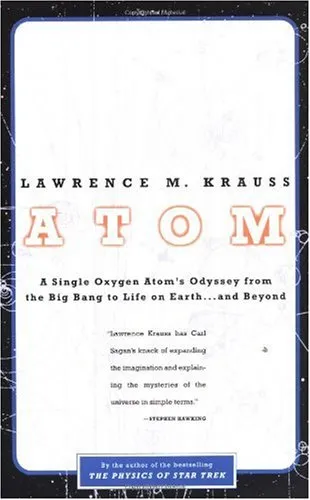
Atom - A Single Oxygen Atoms Journey from the Big Bang to Life on Earth...and Beyond
Lawrence M. Krauss
2001
View book
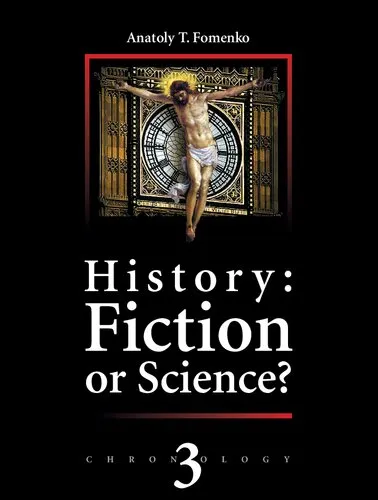
Book guide and evaluation
Anatoly Fomenko
0 reviews
Published
pages
views
Introduction to "History: Fiction or Science? Volume 3" Welcome to "History: Fiction or Science? Volume 3," a groundbreaking and thought-provoking work that applies astronomical methods to challenge and reassess conventional views of historical chronology. In this volume, we d
Before you read
Welcome to "History: Fiction or Science? Volume 3," a groundbreaking and thought-provoking work that applies astronomical methods to challenge and reassess conventional views of historical chronology. In this volume, we delve into the intricate connections between astronomy, ancient texts, and the timeline of historic events, examining the works of luminaries such as Ptolemy, Tycho Brahe, and Copernicus, as well as an in-depth analysis of the Egyptian zodiacs.
The book is part of my series that scrutinizes commonly accepted historical narratives, offering a revolutionary perspective on how ancient and medieval history could have been incorrectly reconstructed. By integrating mathematical tools, astronomical measurements, and critical source analysis, this volume presents a bold case for revising traditional timelines, illuminating the fascinating ways in which science and history intersect.
Let us embark on this intellectual journey to explore history through the lens of astronomy — a perspective that challenges us to rethink what we know about the past and how our history was written.
This volume is focused on applying astronomical methods to assess historical chronology. The idea is simple yet revolutionary: the study of celestial phenomena recorded in historical documents offers a method to verify or challenge the traditional dating of historical events.
One of the critical sections of the book is the analysis of Claudius Ptolemy's "Almagest," an influential work that has long been the cornerstone of classical astronomy and the chronological foundation of many historical events. By scrutinizing Ptolemy's astronomical observations, I argue that there are inconsistencies and fabricated data that suggest his works were created or retroactively altered during the Middle Ages.
Another key section examines the works of Tycho Brahe and Nicolaus Copernicus, pioneers widely credited with reshaping our understanding of celestial mechanics. My analysis sheds light on the possibility that their scientific endeavors may have taken place in a vastly different timeline than is widely believed.
Lastly, the Egyptian zodiacs come under rigorous scrutiny. These ancient symbols hold detailed astronomical information, but through my research, I assert that their conventional dating is often misinterpreted. By applying mathematical analysis, I offer new insights into their actual age and what they tell us about chronology.
Through this detailed investigation, the book challenges the established framework of historical chronology, urging readers to critically evaluate the relationship between astronomy and historical narratives.
"If history has been written by scholars who misunderstood or manipulated astronomical data, then correcting the timeline becomes not just a possibility but an obligation."
"Astronomy may not lie, but when its findings are misused to manufacture chronology, we must question everything we think we know about history."
"A mere correlation of celestial events and historical records can unlock forgotten truths that have been hidden in the dusty tomes of antiquity."
The significance of "History: Fiction or Science? Volume 3" cannot be overstated. It challenges the deeply rooted assumptions upon which much of our historical knowledge is based. By combining the rigor of mathematical sciences with the meticulous analysis of historical records, this volume lays the groundwork for a new understanding of how history can and should be studied.
This book is not just an exploration of history — it is a call to action for scholars, researchers, and readers to adopt a more scientifically rigorous approach when reconstructing the past. It provides fresh insights into how ancient civilizations understood the cosmos and used celestial observations to chronicle their lives. Most importantly, it highlights the critical role of interdisciplinary research in uncovering forgotten truths.
Whether you are a historian, an astronomer, or simply someone who enjoys questioning conventional wisdom, this book offers you a compelling opportunity to rethink how history has been constructed and preserved through the ages. Dive into the world of astronomical chronology and prepare to challenge everything you thought you knew about the past.
Your question is answered in the context of this title and author. Each answer uses 2 points.
0 reviews, 3.5 average out of 5
Sign in to publish a review.
Ask a focused question and learn from the community.
Related references that continue this learning path.
Lawrence M. Krauss
Jeffrey O. Bennett,Megan O. Donahue,Nicholas Schneider,Mark Voit
Jeffrey O. Bennett,Megan O. Donahue,Nicholas Schneider,Mark Voit
Isaac Newton (editor);Florian Cajori (editor);Andrew Motte (editor)