English-Greek dictionary ; a vocabulary of the Attic language
Sidney Chawner Woodhouse
1910
View book
Book guide and evaluation
J. P. Louw,Eugene Albert Nida
0 reviews
Published
pages
views
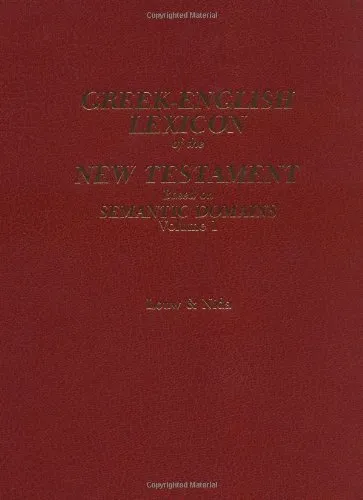
Greek-English Lexicon of the New Testament: Based on Semantic Domains Biblical Greek Lexicography, Semantic Analysis of New Testament Language Authoritative resource: Greek-English Lexicon of the New Testament: Based on Semantic Domains for serious biblical language study. A
Before you read
The Greek-English Lexicon of the New Testament: Based on Semantic Domains stands as a landmark achievement in biblical studies, offering scholars, translators, and theologians a meticulously structured tool for understanding the Greek of the New Testament. Crafted by J. P. Louw and Eugene Albert Nida, this work revolutionizes lexicography by organizing vocabulary according to semantic fields rather than traditional alphabetical listings.
Rather than simply displaying words in isolation, the Lexicon groups them by meaning and conceptual relationships, enabling readers to see how linguistic elements interact within a given historical and theological context. This method provides greater insight into the intent and nuance of New Testament authors, helping users uncover layers of meaning often obscured by direct translation approaches.
The work is designed for serious readers—academics, clergy, translators, and advanced students—who seek to go beyond surface-level comprehension and engage in deep semantic analysis. While the publication year is essential for bibliographic reference, precise data is marked as Information unavailable due to the absence of a reliable public source within this context.
This book delivers transformative tools and perspectives for the interpretation of biblical Greek texts, grounded in semantic theory and practical scholarship.
One of the key takeaways is the thematic organization of vocabulary into semantic domains, which helps contextualize terms within broader cultural and theological frameworks.
It fosters clarity in translation decisions, reduces interpretive bias, and enhances textual fidelity by highlighting the interconnectedness of language elements.
The Lexicon also functions as a bridge between linguistic theory and practical application in exegesis, making it an invaluable companion for anyone dealing with New Testament Greek.
“Understanding meaning is not a matter of single words, but of their relationships and functions within discourse.” Unknown
“Semantic domains liberate translators from rigid lexical equivalence, allowing them to convey meaning accurately across languages.” Unknown
“In Koine Greek, context is king—semantic grouping unveils patterns hidden to the casual reader.” Unknown
For those committed to authentic biblical interpretation, the Greek-English Lexicon of the New Testament: Based on Semantic Domains offers unparalleled guidance.
Its innovative approach addresses the inherent challenges in translating ancient texts into modern languages. By organizing vocabulary according to semantic relationships, it not only enhances linguistic understanding but also aids theological accuracy.
This work matters because it empowers translators and readers to preserve the intent of original authors while making the text accessible to contemporary audiences. It is both a scholarly reference and a practical tool for ministry, academic research, and advanced language study.
The Greek-English Lexicon of the New Testament: Based on Semantic Domains invites readers into a deeper experience of biblical texts through its precise and thoughtful structure.
For academics, translators, and serious students, this is not merely a lexicon—it is a roadmap to richer, more nuanced comprehension. Its emphasis on semantic fields transforms the way biblical Greek is studied, making it a touchstone work for anyone engaged in rigorous scriptural analysis.
If you seek to enhance your understanding of New Testament language, invest time in this lexicon. Read it, share it with colleagues, and discuss its insights in scholarly and faith-based circles. In doing so, you participate in the ongoing tradition of preserving and interpreting a foundational text of human history.
Your question is answered in the context of this title and author. Each answer uses 2 points.
0 reviews, 5.0 average out of 5
Sign in to publish a review.
Ask a focused question and learn from the community.
Related references that continue this learning path.
Sidney Chawner Woodhouse
Michael McCarthy,Felicity O’Dell