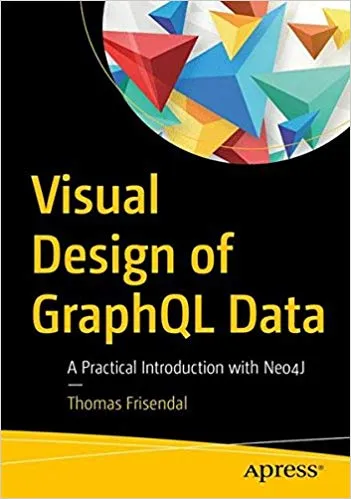
Visual Design of GraphQL Data: A Practical Introduction with Legacy Data and Neo4j
Thomas Frisendal
2018
View book
Book guide and evaluation
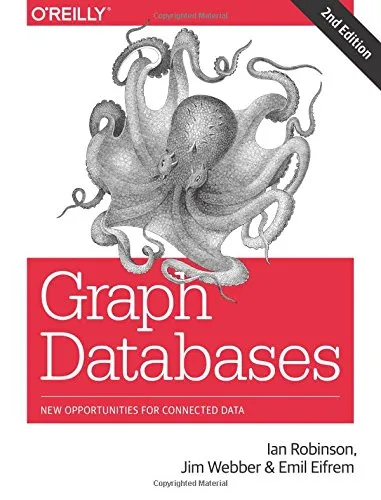
Ian Robinson,Jim Webber,Emil Eifrem
0 reviews
Published
pages
views
Introduction to "Graph Databases: New Opportunities for Connected Data" In an era where data volumes and complexity continue to grow exponentially, traditional databases struggle to efficiently manage highly interconnected data. "Graph Databases: New Opportunities for Connecte
Before you read
In an era where data volumes and complexity continue to grow exponentially, traditional databases struggle to efficiently manage highly interconnected data. "Graph Databases: New Opportunities for Connected Data" offers a comprehensive guide to understanding, using, and implementing graph databases to tackle these challenges head-on. Authored by Ian Robinson, Jim Webber, and Emil Eifrem, this book delves deep into the concepts that make graph databases a powerful tool for managing connected data.
Graph databases represent a significant leap forward for data management in situations where relationships between data points are as crucial as the data itself. This book provides an exhaustive exploration of graph databases, starting from the foundational concepts and progressing to full-scale implementation and optimization.
In the initial chapters, the authors lay down the conceptual underpinnings of graph data structures, explaining how they inherently support the structure of connected data. They elucidate why graph databases can model real-world entities and their relationships more naturally compared to traditional relational databases.
As the narrative progresses, readers encounter practical implementations, case studies, and real-world applications of graph databases. Each chapter builds on the last, equipping readers with the skills needed to handle various data challenges effectively. The authors also explore different graph database technologies, with a particular focus on Neo4j, reflecting the authors' deep expertise in this leading graph database technology.
“Graph databases treat relationships not as a schema design flaw, but as an essential part of the data model.”
“In a world that's increasingly connected, our databases must evolve to provide faster insights and deeper understanding of complex networks.”
As organizations face an increasing need to manage complex data with numerous interconnections, understanding and harnessing the power of graph databases has never been more critical. This book not only provides the conceptual framework necessary for this understanding but also offers practical guidance that readers can apply in real-world settings. By adopting graph databases, businesses can unlock new insights, optimize operations, and gain competitive advantages.
Further, "Graph Databases: New Opportunities for Connected Data" does an exceptional job of making a complex topic accessible to a wide audience, from database novices to seasoned professionals. The authors' passion and expertise shine through, making this an essential read for anyone involved in data management, analysis, or architecture.
Your question is answered in the context of this title and author. Each answer uses 2 points.
0 reviews, 4.5 average out of 5
Sign in to publish a review.
Ask a focused question and learn from the community.
Related references that continue this learning path.
Thomas Frisendal

Michael L. Brodie (auth.),Alexander T. Borgida,Vinay K. Chaudhri,Paolo Giorgini,Eric S. Yu (eds.)