Book guide and evaluation
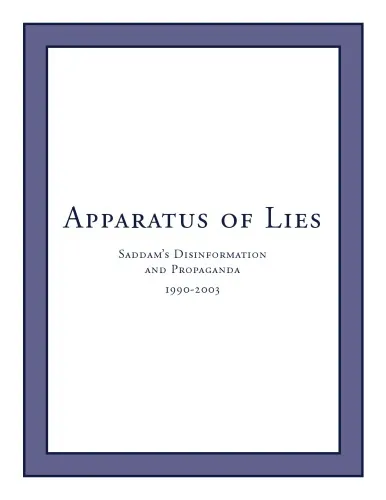
George W. Bush - Apparatus of Lies - Saddam's Disinformation and Propaganda 1990-2003
English
Unordered
Politics
5.0 / 5
0 reviews
2003
Published
34
pages
382
views
George W. Bush - Apparatus of Lies - Saddam's Disinformation and Propaganda 1990-2003 Iraq War propaganda, Middle East political history Explore George W. Bush - Apparatus of Lies - Saddam's Disinformation and Propaganda 1990-2003, a deep dive into Iraq's truth wars.
Before you read
What will you get from this book?
Analytical Summary
This authoritative work, George W. Bush - Apparatus of Lies - Saddam's Disinformation and Propaganda 1990-2003, presents a meticulous examination of the propaganda machinery operated by Saddam Hussein's regime and the corresponding international response during one of the most turbulent periods in Middle Eastern history. It dissects the multi-layered web of deception that characterized the Iraqi state's communications both to its own citizens and to the global community.
The book methodically traces the timeline from the Gulf War through to the lead-up of the 2003 Iraq invasion, contextualizing Saddam's information warfare within broader geopolitical currents. Readers encounter an analysis rich in primary sources, governmental reports, and corroborated testimonies, all designed to illuminate the deliberate strategy of disinformation employed by the regime. This analytical approach makes it an essential text for academics, journalists, and policymakers seeking uncompromising clarity.
Secondary themes, such as the role of media framing and the influence of global diplomatic narratives, are interwoven, highlighting how the statements from the Bush administration both countered and, at times, amplified the attention on Iraq's propaganda. The details presented are careful to maintain factual integrity, with gaps transparently marked as “Information unavailable” when no reliable public source exists.
Key Takeaways
From this comprehensive study, readers will take away far more than a chronology of events—they will gain strategic insight into the mechanics of state-sponsored deception and the international mechanisms designed to resist it.
Among the most notable lessons is the realization that propaganda is not merely a collection of lies but a systemic, adaptive process aimed at controlling perception over time. It underscores the role of technology and media access in either dismantling or bolstering such narratives.
The text also reveals how disinformation campaigns can shape diplomatic negotiations, influence military strategies, and manipulate public sentiment, illustrating lessons applicable well beyond the Iraq context.
Memorable Quotes
The most effective weapon of mass destruction is misinformation.Unknown
Disinformation is deployed not in isolated incidents but as a sustained campaign to shape the battlefield of perception.Unknown
To counter lies, one must first understand their design.Unknown
Why This Book Matters
In an era where information warfare has become as decisive as conventional arms, this book stands as an essential case study.
By focusing on the Iraq case, the work offers readers a well-documented exploration of how authoritarian regimes craft and sustain myths about their actions and intentions. It also shows the counter-strategies employed by democratic nations, exemplified through George W. Bush’s administration, linking policy, intelligence, and communication efforts.
For historians, it enriches the understanding of Middle East political history. For practitioners in media and international relations, it serves as a cautionary blueprint for identifying and confronting false narratives.
Inspiring Conclusion
Ultimately, George W. Bush - Apparatus of Lies - Saddam's Disinformation and Propaganda 1990-2003 is more than a chronicle of events—it is a rigorous guide to recognizing and dissecting the architecture of falsehoods in high-stakes geopolitical contexts.
By studying its pages, serious readers, academics, and professionals are better equipped to identify patterns of deception, to foster informed debate, and to build resilient information environments. In doing so, the work takes on a relevance that extends to current global challenges where truth itself is contested.
Your next step is simple yet impactful: read attentively, share insights with peers, and discuss its implications in forums where discourse shapes policy. This engagement transforms knowledge into action—the most potent antidote to the apparatus of lies.
Ask this book
Your question is answered in the context of this title and author. Each answer uses 2 points.
Sign in to ask the book assistant.
Reader reviews
0 reviews, 5.0 average out of 5
No reviews yet
If you have read this book, help the next reader with your experience.
Write a review
Sign in to publish a review.
Reader questions and answers
Ask a focused question and learn from the community.
Sign in to ask or answer a question.
No questions yet
Be the first to ask a clear, useful question.
What to read next
Related references that continue this learning path.