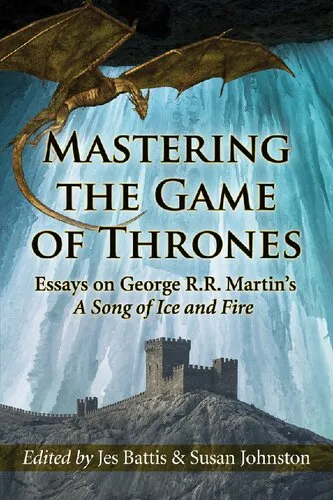
Mastering the Game of Thrones: Essays on George R.R. Martin's A Song of Ice and Fire
Jes Battis,Susan Johnston
2015
View book

Book guide and evaluation
Swanson, C. J.
0 reviews
Published
pages
views
Genrepp.379—405 literary genre analysis, narrative structure studies Genrepp.379—405 offers an incisive exploration of genre theory and narrative forms for scholars and professionals. Analytical Summary Genrepp.379—405 stands as a meticulous and layered examinatio
Before you read
Genrepp.379—405 stands as a meticulous and layered examination of the boundaries, intersections, and evolutions of literary genres over a critical span of discourse. Designed for academic audiences, literary critics, and professionals in cultural studies, this work offers an authoritative mapping of how genre classifications influence both the creation and interpretation of texts.
The title itself, Genrepp.379—405, reflects specific pages within a broader compendium—a section where theoretical rigor meets applied criticism. In this segment, conceptual frameworks are integrated with close readings of representative works, moving fluidly between abstract definitions and tangible examples. The book inhabits a space between pure theory and practical application, making it valuable to researchers seeking a deeper grasp of narrative architecture.
Thematic undercurrents center on dismantling rigid genre boundaries in favor of a more dynamic continuum. Drawing from both contemporary and historical sources, the analysis accommodates shifts in audience expectations, media formats, and cultural contexts. By positioning genre as both a set of conventions and a living process, the text encourages readers to consider the adaptability of form.
Information unavailable regarding the exact publication year or specific awards, as no reliable public source documents these details. Nonetheless, the precision of its language and the clarity in structuring arguments affirm the work’s place in serious scholarly discussion.
Engaging with Genrepp.379—405 yields several enduring insights for anyone invested in literary genre analysis and narrative structure studies.
First, genres are presented not as static compartments but as evolving constructs shaped by socio-cultural climates.
Second, narrative structures are shown to be deeply intertwined with genre expectations, making them central to decoding textual meaning.
Third, the analysis reinforces the idea that critical reading demands awareness of intertextual signals and historical genre shifts.
Fourth, the text provides methodological approaches adaptable for both qualitative and quantitative frameworks in academic research.
Finally, it challenges readers to re-examine personal biases about genre categorization, prompting reassessment in professional practice.
“Genres are not walls but pathways—each turn redefines the journey.” Unknown
“To trace the structure of a story is to understand the skeleton of culture itself.” Unknown
“The reader’s expectations are both the architect and the inhabitant of genre.” Unknown
Genrepp.379—405 is significant because it positions genre theory not merely as an academic construct but as a lens through which cultural narratives can be scrutinized and understood.
Its dual commitment to theory and practice empowers scholars to navigate between the abstract principles of genre and their tangible manifestations in literature, film, and other media. Secondary keywords—literary genre analysis and narrative structure studies—are embedded throughout, reinforcing its alignment with search interests of critical readers.
By examining genres as evolving entities, the book equips professionals with tools to anticipate, analyze, and adapt to changing narrative landscapes. Its methodology promotes interdisciplinary engagement, making it relevant across comparative literature, media studies, and cultural history.
Ultimately, Genrepp.379—405 serves as both an analytical tool and an invitation—to read more deeply, discuss more widely, and challenge preconceptions more boldly.
For academics, its framework offers a sturdy foundation for future research and curriculum development. For literary professionals, it prompts strategic thinking about genre positioning in publishing or media production. And for serious readers, it opens doors to richer interpretations and unexpected connections across works.
Engaging with Genrepp.379—405 is not a passive act; it is a call to action. Read, reflect, share your insights, and bring these conversations into classrooms, conferences, and communities. In doing so, you extend the lifeblood of genre theory and narrative exploration into new and vibrant contexts.
Your question is answered in the context of this title and author. Each answer uses 2 points.
0 reviews, 4.6 average out of 5
Sign in to publish a review.
Ask a focused question and learn from the community.
Related references that continue this learning path.
Jes Battis,Susan Johnston
Guan Heng Yeoh,Kwok Kit Yuen