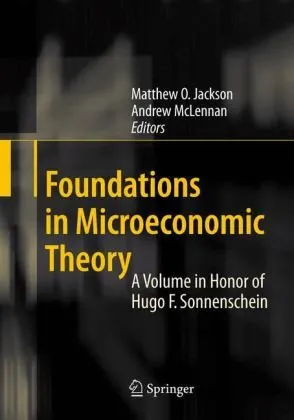
Foundations in Microeconomic Theory: A Volume in Honor of Hugo F. Sonnenschein
Matthew O. Jackson,Andrew McLennan
2008
View book
Book guide and evaluation
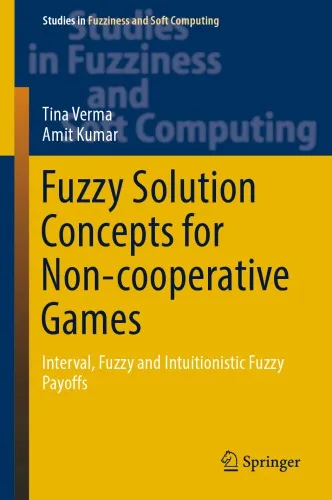
Tina Verma,Amit Kumar
0 reviews
Published
pages
views
Welcome to 'Fuzzy Solution Concepts for Non-cooperative Games. Interval, Fuzzy and Intuitionistic Fuzzy Payoffs', a groundbreaking exploration into the intersection of game theory and fuzzy logic. As the nature of problems and decision-making processes continue to evo
Before you read
Welcome to 'Fuzzy Solution Concepts for Non-cooperative Games. Interval, Fuzzy and Intuitionistic Fuzzy Payoffs', a groundbreaking exploration into the intersection of game theory and fuzzy logic. As the nature of problems and decision-making processes continue to evolve, the need for innovative approaches grows stronger. This book stands as a pivotal resource for scholars, practitioners, and enthusiasts interested in applying fuzzy logic to non-cooperative game theory. Here, we introduce you to the invaluable concepts and methodologies that await within these pages.
This book delves into the dynamics of non-cooperative games, extending traditional models by incorporating uncertainty through fuzzy logic. The focus is on developing solution concepts when dealing with interval, fuzzy, and intuitionistic fuzzy payoffs. We systematically guide readers through foundational aspects and intricate details of using fuzzy logic to embody real-world indeterminacies in strategic games.
Each chapter is meticulously structured to offer comprehensive insights into topics such as fuzzy set theory, intuitionistic fuzzy logic, and their integration with game-theoretical frameworks. The book is replete with examples and case studies that highlight practical applications and potential challenges. Our goal is to not only address the theoretical underpinnings but also provide actionable knowledge that can be utilized in fields such as economics, social sciences, and artificial intelligence.
"In a world teeming with uncertainty, capturing the nuance of imprecision is the true essence of strategic equilibriums."
"Non-cooperative games mirror the unpredictability of human interactions, and fuzzy logic offers the lens to perceive clarity in chaos."
In an era where computational advancements and complex systems dominate, understanding and implementing decision-making under uncertainty is crucial. 'Fuzzy Solution Concepts for Non-cooperative Games’ transcends traditional boundaries by introducing fuzzy logic as a flexible and robust mechanism to interpret and handle uncertainty in game-theoretical contexts.
As disciplinary lines blur, the fusion of game theory with fuzzy logic paves the way for innovative solutions across domains such as economics, robotics, and data science. This book offers an essential scholarly contribution to the literature, advancing both theoretical constructs and practical applications.
Whether you are a researcher, student, or professional, this book equips you with the required tools and methodologies to navigate and leverage the power of fuzzy solution concepts in tackling today’s multifaceted challenges.
Your question is answered in the context of this title and author. Each answer uses 2 points.
0 reviews, 4.0 average out of 5
Sign in to publish a review.
Ask a focused question and learn from the community.
Related references that continue this learning path.
Matthew O. Jackson,Andrew McLennan
Leon A. Petrosyan,Vladimir V. Mazalov,Nikolay A. Zenkevich