Numerical Solution of Partial Differential Equations in Science and Engineering
Leon Lapidus,George F. Pinder
1999
View book
Book guide and evaluation
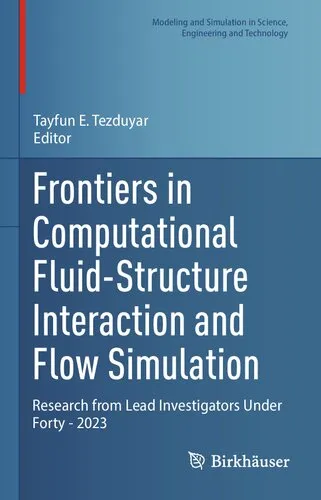
Tayfun E. Tezduyar (editor)
0 reviews
Published
pages
views
Introduction Welcome to Frontiers in Computational Fluid-Structure Interaction and Flow Simulation: Research from Lead Investigators Under Forty - 2023, a groundbreaking exploration of the latest advancements in computational science and engineering. This volume brings togethe
Before you read
Welcome to Frontiers in Computational Fluid-Structure Interaction and Flow Simulation: Research from Lead Investigators Under Forty - 2023, a groundbreaking exploration of the latest advancements in computational science and engineering. This volume brings together a powerful collection of research contributions from some of the brightest young minds shaping the field of computational fluid-structure interaction (FSI) and flow simulation. It emphasizes innovative methodologies, cutting-edge technologies, and the profound impact of multidisciplinary approaches in solving challenging scientific and engineering problems. As part of the Modeling and Simulation in Science, Engineering and Technology series, this book serves as both an in-depth technical resource for researchers and a source of inspiration for industry professionals.
The chapters in this book are authored exclusively by leading scientists and engineers under the age of forty, making it a unique perspective on the future of FSI and computational flow simulation. These contributions cover a wide array of topics, from numerical algorithms and high-performance computing techniques to domain-specific applications in aerodynamics, biomechanics, and energy systems.
The book is a tribute to the dynamic and rapidly evolving field of computational FSI and flow simulation, encapsulating the intellectual and scientific vigor of young researchers who are defining the future of the discipline. Each chapter is meticulously designed to reflect the state-of-the-art methodologies and tools, offering both theoretical insights and practical applications.
The content is organized around several critical themes:
What truly stands out is the diversity of applications discussed in this book, which range from the simulation of cardiovascular flows to the aerodynamics of hypersonic vehicles. Each chapter provides a deep dive into a specific problem or domain, while also highlighting the cross-disciplinary approaches that have become a hallmark of modern computational science.
"To simulate is to understand, and to understand is to innovate. Computational science bridges the gap between hypothesis and application."
"The next era of fluid-structure interaction will be defined not by individual achievements but by collaborative breakthroughs across disciplines."
As the demand for more accurate, efficient, and scalable simulation tools continues to grow, this book serves as both a benchmark for the current state of the art and a roadmap for future advancements. It celebrates the critical contributions of young scientists and engineers who are unafraid to challenge conventions and redefine the field. By fostering a spirit of innovation and collaboration, this book ensures that computational FSI and flow simulation remain at the forefront of scientific discovery and technological development.
Whether you are a student, researcher, or industry professional, this book will not only broaden your understanding of computational methods but also inspire you to explore new directions in your own work. With its rich content, interdisciplinary focus, and forward-looking perspective, it holds a special place in the literature of computational science and engineering.
Your question is answered in the context of this title and author. Each answer uses 2 points.
0 reviews, 4.5 average out of 5
Sign in to publish a review.
Ask a focused question and learn from the community.
Related references that continue this learning path.
Leon Lapidus,George F. Pinder

Anastasis Polycarpou,Constantine Balanis
M Rahman,C. A. (editors) Brebbia