

Book guide and evaluation
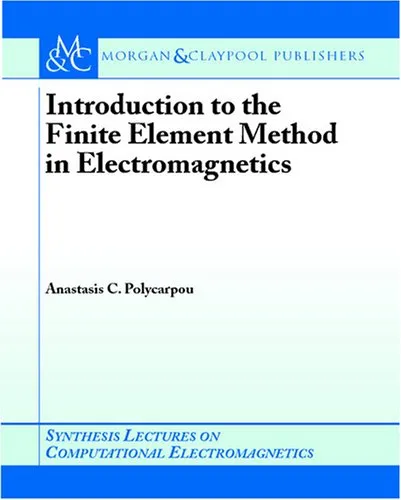
Introduction to the finite element method in electromagnetics
Anastasis Polycarpou,Constantine Balanis
English
Beginner
Engineering
4.5 / 5
0 reviews
2006
Published
126
pages
554
views
Book Summary Understanding electromagnetics is pivotal for innovations in technology and design within the fields of electrical engineering, physics, and applied mathematics. "Introduction to the Finite Element Method in Electromagnetics" by Anastasis Polycarpou and Cons
Before you read
What will you get from this book?
Book Summary
Understanding electromagnetics is pivotal for innovations in technology and design within the fields of electrical engineering, physics, and applied mathematics. "Introduction to the Finite Element Method in Electromagnetics" by Anastasis Polycarpou and Constantine Balanis serves as a fundamental resource for those delving into computational electromagnetic analysis.
The book provides a comprehensive introduction to the finite element method (FEM) - a powerful computational technique essential in solving complex electromagnetic problems. It is meticulously crafted to guide beginners and experts alike through the multifaceted processes entailed in FEM applications. The authors intersperse theoretical foundations with practical insights, ensuring a well-rounded understanding of the method's capabilities and limitations.
The text spans various aspects of electromagnetic theory, including static and dynamic properties, boundary conditions, and complex geometries. Each chapter is designed to build upon the last, creating a seamless learning curve. Moreover, the authors blend mathematical rigor with accessible language, thus democratizing the learning process for a broad audience.
The book is not merely a compendium of equations and methodologies; it eloquently encapsulates real-world applications, engaging readers with diverse use-cases ranging from antenna design to wave propagation. Readers are encouraged to appreciate the delicate balance between theoretical models and computational pragmatism, a crucial skill in engineering disciplines.
Key Takeaways
- Deep understanding of the finite element method and its applications in electromagnetics.
- Step-by-step guidance on problem-solving techniques for complex electromagnetic fields.
- Comprehensive coverage of theoretical concepts complementing computational methods.
- Insightful examples and exercises designed to reinforce learning objectives and practical implementation.
- Attention to boundary conditions and their critical role in problem framing and solving.
Famous Quotes from the Book
"The finite element method is not just a numerical tool, but a gateway to understanding and solving the complexities that discipline the universe of electromagnetics."
"Accuracy in computational methods is achieved not through complexity, but through clarity and comprehension."
Why This Book Matters
In a world increasingly reliant on technological advancement, understanding and applying the finite element method in electromagnetics is essential. The book "Introduction to the Finite Element Method in Electromagnetics" highlights this necessity, emphasizing clarity, practicality, and innovation in education.
The rich blend of theory and application ensures that readers gain not just knowledge but competence in handling real-world scenarios. The book is indispensable to the academic, researcher, and professional communities, providing critical insights into one of the most challenging yet rewarding areas of study. By embarking on this intellectual journey, readers are empowered to innovate, explore, and enhance the modern technological landscape.
Ask this book
Your question is answered in the context of this title and author. Each answer uses 2 points.
Sign in to ask the book assistant.
Reader reviews
0 reviews, 4.5 average out of 5
No reviews yet
If you have read this book, help the next reader with your experience.
Write a review
Sign in to publish a review.
Reader questions and answers
Ask a focused question and learn from the community.
Sign in to ask or answer a question.
No questions yet
Be the first to ask a clear, useful question.
What to read next
Related references that continue this learning path.

Advances in Fluid Mechanics VIII (Wit Transactions on Engineering Sciences)
M Rahman,C. A. (editors) Brebbia
2010
View book

Basics of Fluid Mechanics and Introduction to Computational Fluid Dynamics
Titus Petrila,Damian Trif
2004
View book

Analysis of Electromagnetic Fields and Waves: The Method of Lines (RSP)
Reinhold Pregla
2008
View book