

Analysis and Design of Intelligent Systems using Soft Computing Techniques
Lotfi A. Zadeh (auth.),Patricia Melin,Oscar Castillo,Eduardo Gomez Ramírez,Janusz Kacprzyk,Witold Pedrycz (eds.)
2007
View book
Book guide and evaluation
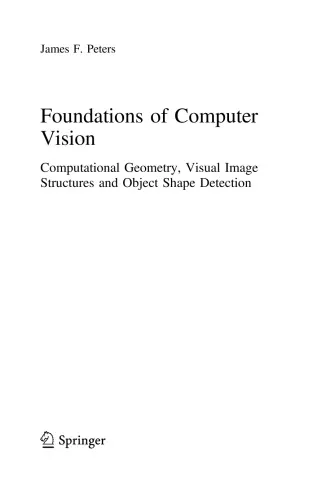
James F. Peters
0 reviews
Published
pages
views
Introduction Welcome to Foundations of Computer Vision: Computational Geometry, Visual Image Structures and Object Shape Detection, a comprehensive guide designed to demystify the complex yet thrilling field of computer vision. This book delves into the underpinnings of co
Before you read
Welcome to Foundations of Computer Vision: Computational Geometry, Visual Image Structures and Object Shape Detection, a comprehensive guide designed to demystify the complex yet thrilling field of computer vision. This book delves into the underpinnings of computer vision, focusing on computational geometry, visual image structures, and the intricacies of detecting object shapes.
In the modern digital age, where visual data is ever-present, understanding and harnessing the power of computer vision is paramount. This book serves as an essential resource, exploring the foundational concepts and advanced methodologies that empower computers to interpret and understand visual information. Throughout the chapters, we dissect the mathematical and theoretical aspects of computational geometry, providing readers with a solid grounding in the geometric principles that form the bedrock of computer vision.
The exploration of visual image structures takes readers through the complexities of image formation, feature extraction, and the representation of visual data. Our deep dive into object shape detection equips readers with the knowledge necessary to implement algorithms that can recognize and analyze the shapes and structures within an image.
By the end of the book, readers will have developed a comprehensive understanding of the synergy between theory and application in computer vision, enabling them to create innovative solutions to real-world challenges.
"In the intricate dance of light, shadows, and surfaces, computer vision becomes the language that translates the visual world into meaningful knowledge."
"Understanding the geometry of the visible unveils the unseen complexities of our world."
In a world increasingly driven by data, the ability to interpret visual information is critical. This book matters because it bridges the gap between abstract theoretical concepts and their application in addressing practical problems. As industries ranging from healthcare to automotive increasingly rely on computer vision for innovation and operational efficiency, this book provides the tools needed for professionals and enthusiasts to make significant contributions.
Furthermore, by taking a foundational approach, the book ensures its readers develop a deep, lasting understanding of computer vision principles, preparing them to tackle future challenges in this fast-evolving field. Whether you are a researcher, a student, or an industry professional, Foundations of Computer Vision offers indispensable insights and serves as a critical stepping stone towards mastery in computer vision.
Your question is answered in the context of this title and author. Each answer uses 2 points.
0 reviews, 4.3 average out of 5
Sign in to publish a review.
Ask a focused question and learn from the community.
Related references that continue this learning path.
Lotfi A. Zadeh (auth.),Patricia Melin,Oscar Castillo,Eduardo Gomez Ramírez,Janusz Kacprzyk,Witold Pedrycz (eds.)

Christian Ronse (auth.),Tetsuo Asano,Reinhard Klette,Chrisitan Ronse (eds.)
Dr. K. Daniilidis (auth.),Prof. Dr. W. Kropatsch,Prof. Dr. R. Klette,Prof. Dr. F. Solina,Prof. Dr. R. Albrecht (eds.)
Alessandro Betti,Marco Gori,Stefano Melacci