Analysis and Design of Intelligent Systems using Soft Computing Techniques
Lotfi A. Zadeh (auth.),Patricia Melin,Oscar Castillo,Eduardo Gomez Ramírez,Janusz Kacprzyk,Witold Pedrycz (eds.)
2007
View book
Book guide and evaluation
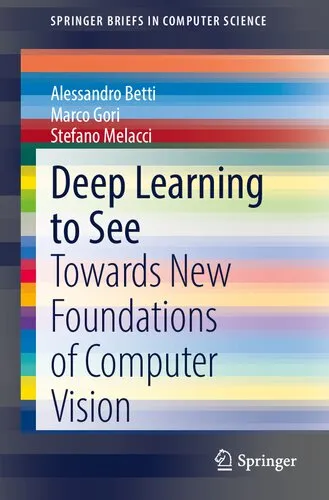
Alessandro Betti,Marco Gori,Stefano Melacci
0 reviews
Published
pages
views
Introduction to "Deep Learning to See: Towards New Foundations of Computer Vision" Welcome to an enlightening journey into the realm of computer vision, where we unravel the intricate relationship between deep learning and the way machines perceive our world. "
Before you read
Welcome to an enlightening journey into the realm of computer vision, where we unravel the intricate relationship between deep learning and the way machines perceive our world. "Deep Learning to See: Towards New Foundations of Computer Vision" is a thought-provoking exploration of the evolving paradigms in computer vision, meticulously crafted for researchers, practitioners, and enthusiasts alike.
At the heart of modern artificial intelligence lies computer vision, a critical discipline that enables machines to interpret and aesthetically understand visual data. This book elucidates the significant leap that deep learning techniques have brought to computer vision, challenging traditional paradigms and setting new standards of performance and accuracy.
The book begins by offering a comprehensive overview of computer vision's evolution, tracing back from early image processing techniques to current state-of-the-art deep learning models. We delve into the inner workings of convolutional neural networks (CNNs), exploring how they revolutionized image classification, object detection, and segmentation tasks. Furthermore, the book highlights advanced topics such as generative adversarial networks (GANs) and their application in creative processes and data augmentation.
Chapters are dedicated to methodological advances and practical insights, including transfer learning, multi-task learning, and attention mechanisms. These discussions are coupled with theoretical underpinnings that clarify the substantial shift from feature engineering to feature learning, encapsulating a paradigm shift in how data is interpreted by machines.
The readers will gain:
"The evolution of seeing has moved from a reflexive action to a deliberate perception—deep learning powers this metamorphosis."
"In the intersection of pixels and powerful neural architectures, we find the means to teach computers not just to see, but to understand."
"As we navigate the realms of seeing, we realize that vision is not just what is seen, but what is felt."
This book matters because it does not merely chronicle the progress in computer vision but sets the stage for future discoveries. It confronts the challenging questions of visual comprehension and representation, preparing the reader to contribute to a rapidly advancing field. By assimilating the insights and methodologies in this book, readers stand at the forefront of converting visual data into meaningful, impactful solutions. Whether you are a researcher pioneering new algorithms, an engineer developing the latest applications, or a curious learner, this book serves as an essential resource to deepen your understanding and inspire innovation.
Your question is answered in the context of this title and author. Each answer uses 2 points.
0 reviews, 4.3 average out of 5
Sign in to publish a review.
Ask a focused question and learn from the community.
Related references that continue this learning path.
Lotfi A. Zadeh (auth.),Patricia Melin,Oscar Castillo,Eduardo Gomez Ramírez,Janusz Kacprzyk,Witold Pedrycz (eds.)

Christian Ronse (auth.),Tetsuo Asano,Reinhard Klette,Chrisitan Ronse (eds.)