

The Third Pillar: How Markets and the State Leave the Community Behind
Raghuram Rajan
2019
View book
Book guide and evaluation
Das,Mr. Satyajit
0 reviews
Published
pages
views
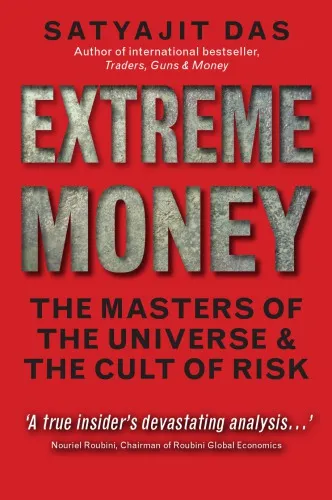
Introduction to "Extreme Money: The Masters of the Universe and the Cult of Risk" In the modern era, where financial systems dominate global economies, few books capture the complex interplay of money, power, and speculation as skillfully as "Extreme Mone
Before you read
In the modern era, where financial systems dominate global economies, few books capture the complex interplay of money, power, and speculation as skillfully as "Extreme Money: The Masters of the Universe and the Cult of Risk". Written by Satyajit Das, this book is an in-depth exploration of the financial world's inner workings, its obsession with risk-taking, and its profound ability to shape societies. The author, with his vast experience as a financial consultant, delivers a unique blend of storytelling, deep analysis, and biting critique of the culture that underpins modern capitalism.
Unlike traditional economic literature, "Extreme Money" does not merely explain numbers or theories. Instead, it delves into the psychological and cultural aspects of the global financial system, unraveling how the pursuit of profits, innovation, and risk has not only fueled economic growth but also created crises of unprecedented magnitudes. Through sharp insights and numerous real-world examples, Satyajit Das paints a vivid picture of a world deeply entwined with money yet perpetually teetering on the brink of disaster.
"Extreme Money" begins by tracing the evolution of money as a concept and its transformation from a tool of trade to a complex and abstract system of value. Das explains how modern financial instruments, such as derivatives and exotic securities, have grown increasingly intricate and disconnected from real-world assets. These innovations, while profitable for a select few, often come at a high cost for global stability.
The book takes readers inside the boardrooms of financial institutions and hedge funds, showcasing how professionals—dubbed "Masters of the Universe"—operate in a world driven by greed, short-term gains, and an often reckless disregard for consequences. Das highlights the seductive allure of risk-taking, fueled by the belief that markets always self-correct. However, he points out that this belief is flawed, as seen during catastrophic events like the 2008 financial crisis.
In subsequent chapters, the book explores key concepts such as leverage, innovation, and the ethics (or lack thereof) within financial systems. Das skillfully breaks down complex financial terms, explaining how products like derivatives, credit-default swaps, and other instruments became weapons of mass destruction when misused. He argues that the financial sector's obsession with abstract profits ignores societal costs, such as inequality, unemployment, and economic instability.
Ultimately, "Extreme Money" is not just an indictment of Wall Street—it examines societal complicity in creating a world where money rules above all else. The book poses difficult questions about whether the global economy can ever reform itself or if we are doomed to repeat cycles of boom and bust endlessly.
"Extreme Money" holds significant importance in today's world, where financial crises and systemic failures have far-reaching consequences. It not only educates readers about how financial systems operate but also offers a candid critique of the individuals and ideologies that shape them. For policymakers, economists, and everyday readers alike, the book serves as a cautionary tale—a clarion call for a more sustainable, balanced approach to understanding and managing money.
Satyajit Das's detailed storytelling and incisive analysis make this book an essential read for anyone seeking to decode the mysteries of modern finance. By emphasizing both the technical and human aspects of the financial industry, "Extreme Money" challenges conventional business wisdom and encourages a rethinking of how societies value risk, reward, and progress.
Your question is answered in the context of this title and author. Each answer uses 2 points.
0 reviews, 4.3 average out of 5
Sign in to publish a review.
Ask a focused question and learn from the community.
Related references that continue this learning path.
Raghuram Rajan

Anonymous Hedge Fund Manager