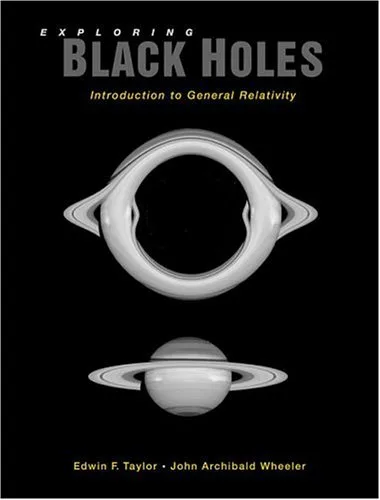
Book guide and evaluation
Exploring Black Holes: Introduction to General Relativity
Edwin F. Taylor,John Archibald Wheeler
English
Beginner
Cosmology
4.5 / 5
0 reviews
2000
Published
345
pages
589
views
Introduction to 'Exploring Black Holes: Introduction to General Relativity' Written by the esteemed physicists Edwin F. Taylor and John Archibald Wheeler, 'Exploring Black Holes: Introduction to General Relativity' offers a unique and engaging approach to understanding Einstei
Before you read
What will you get from this book?
Introduction to 'Exploring Black Holes: Introduction to General Relativity'
Written by the esteemed physicists Edwin F. Taylor and John Archibald Wheeler, 'Exploring Black Holes: Introduction to General Relativity' offers a unique and engaging approach to understanding Einstein's theory of general relativity, especially through the lens of black holes. This book is crafted for undergraduates and enthusiasts alike, providing a path to comprehend complex ideas without requiring extensive mathematical preliminaries.
Detailed Summary of the Book
The book delves into the fundamentals of general relativity by focusing on black holes, which serve as both dramatic and pedagogically useful settings. Beginning with Einstein's groundbreaking thoughts on gravity, space, and time, Taylor and Wheeler guide the reader through the essentials of spacetime geometry and the bending of light. Without the heavy reliance on advanced mathematics, the authors illuminate these sophisticated concepts, making them accessible through intuitive explanations, diagrams, and practical calculations that require only basic calculus.
The chapters progressively introduce readers to the concepts of event horizons, singularity points, and the implications of mass on the fabric of spacetime. There’s an emphasis on the practical applications of these theories, such as their significance in understanding the universe's fate and the technology in our daily lives. Taylor and Wheeler employ a narrative style that not only educates but also stimulates curiosity and wonder, making the book a compelling read.
Key Takeaways
- Gravitation is not a force, but the result of spacetime curvature caused by mass.
- Black holes provide a natural laboratory for exploring the concepts of modern physics.
- The concept of event horizons provides insight into what can be understood from beyond observable phenomena.
- Relativity can be understood with minimal use of advanced mathematics, focusing instead on conceptual clarity and geometric thinking.
Famous Quotes from the Book
"Black holes are where God divided by zero."
"The boundary of a black hole is the perfect proving ground for Einstein's theory of general relativity."
Why This Book Matters
'Exploring Black Holes: Introduction to General Relativity' holds significant importance for both educational and scientific communities. It serves as an invaluable resource for achieving a nuanced understanding of general relativity without being bogged down by overwhelming mathematical details. For educators, it offers a gateway to introduce students to high-level physics through palpable and engaging means. Moreover, for enthusiasts, it opens the door to Einstein's universe—a realm filled with wonders like black holes that challenge our perception of reality.
This book pushes the boundaries of traditional teaching by employing the black hole, a cosmic enigma, as an educational tool that not only explains complex gravitational phenomena but also inspires a deeper appreciation for the universe's mysteries. Its contribution to the popularization and understanding of physics ensures that both current and future generations can continue to explore and expand upon Einstein's legacy.
Ask this book
Your question is answered in the context of this title and author. Each answer uses 2 points.
Sign in to ask the book assistant.
Reader reviews
0 reviews, 4.5 average out of 5
No reviews yet
If you have read this book, help the next reader with your experience.
Write a review
Sign in to publish a review.
Reader questions and answers
Ask a focused question and learn from the community.
Sign in to ask or answer a question.
No questions yet
Be the first to ask a clear, useful question.
What to read next
Related references that continue this learning path.