Book guide and evaluation
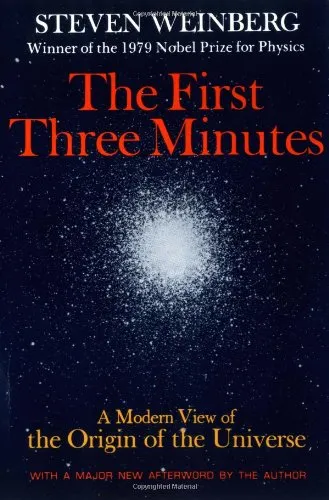
The first three minutes
Steven Weinberg
English
Beginner
Cosmology
4.5 / 5
0 reviews
1993
Published
168
pages
584
views
Introduction Welcome to the compelling journey through time and space with "The First Three Minutes" by Steven Weinberg. In this enlightening book, I unravel the complex narrative of the universe’s inception, unfolding the intricate details of the first moments following the B
Before you read
What will you get from this book?
Introduction
Welcome to the compelling journey through time and space with "The First Three Minutes" by Steven Weinberg. In this enlightening book, I unravel the complex narrative of the universe’s inception, unfolding the intricate details of the first moments following the Big Bang. My intention is to provide both science enthusiasts and casual readers an accessible and enthralling exploration of the universe's origin.
Summary of "The First Three Minutes"
This book delves into the conceptual foundation and scientific theories concerning the universe's birth and its progression during the first three minutes of existence. It breaks down sophisticated cosmological concepts and lays them out in a manner understandable to those unacquainted with physics. I guide the reader through a timeline starting from the initial singularity, progressing through the intense heat and rapid expansion of the Big Bang, and finally to the nascent form of matter which eventually aspired to become galaxies, stars, and planets. This work not only paints a vivid picture of the universe’s early moments, but it also aligns these physical phenomena with observable data derived from cosmic background radiation and particle physics. Through meticulous explanations, I bring forward the historical context of scientific discoveries, offering insight into how understanding of the universe's beginning has evolved over time.
Key Takeaways
- The intricate dance of subatomic particles shaping the universe’s early structure.
- An understanding of the scientific method through cosmological discoveries.
- Insight into the ways modern physics and stellar observations validate cosmological theories.
- Adoption of a historical perspective on the progression of human understanding of the cosmos.
- How the universe cooled and expanded to allow the formation of chemical elements.
Famous Quotes from the Book
"The more the universe seems comprehensible, the more it also seems pointless."
"It is an enormous challenge to grasp something as foreign to our usual understanding as the first few minutes of the universe."
"With or without religion, you would have good people doing good things and evil people doing evil things. But for good people to do evil things, that takes religion."
Why This Book Matters
"The First Three Minutes" is foundational in bridging the gap between academic physics and public understanding. It provides a significant contribution to popular science literature by framing the universe's complex beginnings in a narrative that both informs and inspires wonder. The book has influenced both scientific communities and general readers by encapsulating the essence of cosmological developments in a digestible format. More than just a recount of events, it emphasizes the elegance of the universe’s orchestration and the continuing quest for knowledge that defines human existence. Given the book's impactful reach, it serves as a pivotal resource for those intrigued by the mysteries of our universe and a beacon for fostering intellectual curiosity about the cosmos.
Ask this book
Your question is answered in the context of this title and author. Each answer uses 2 points.
Sign in to ask the book assistant.
Reader reviews
0 reviews, 4.5 average out of 5
No reviews yet
If you have read this book, help the next reader with your experience.
Write a review
Sign in to publish a review.
Reader questions and answers
Ask a focused question and learn from the community.
Sign in to ask or answer a question.
No questions yet
Be the first to ask a clear, useful question.
What to read next
Related references that continue this learning path.
Black Holes and Time Warps: Einstein’s Outrageous Legacy
Kip S. Thorne,Stephen Hawking
1995
View book