Variable Properties in Language Their Nature and Acquisition (Georgetown University Round Table on Languages and Linguistics Series)
David W. Lightfoot;Jonathan Havenhill;
2019
View book
Book guide and evaluation
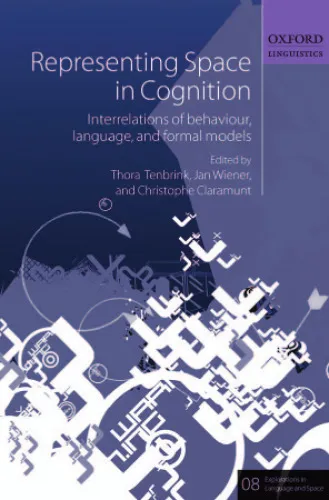
Thora Tenbrink, Jan M. Wiener, Christophe Claramunt
0 reviews
Published
pages
views
Explorations in Language and Space Linguistic spatial cognition, interdisciplinary communication research Explorations in Language and Space offers deep insights into how language shapes spatial thinking and understanding. Analytical Summary Explorations in Language and Spa
Before you read
Explorations in Language and Space stands as a seminal work at the intersection of linguistics, cognitive science, and spatial analysis. Authored by Thora Tenbrink, Jan M. Wiener, and Christophe Claramunt, this scholarly volume brings together thought‑provoking contributions that examine how language affects our conceptualization and communication of spatial information. Drawing from empirical research, theoretical frameworks, and interdisciplinary collaboration, the book offers both depth of analysis and breadth of perspective, making it a vital resource for academics, professionals, and serious readers intent on understanding how linguistic structures and spatial cognition co‑evolve.
What sets this work apart is its rigorous analytical approach, grounded in empirical studies yet enriched by cross‑disciplinary insights. The authors and contributors delve into how spatial concepts are expressed in different languages, how linguistic patterns can influence wayfinding and navigation, and how these insights can be applied to domains such as geographic information science, urban planning, and human‑computer interaction. Alongside meticulous methodological detail, the book encourages critical reflection about the role of language in shaping our mental maps of the world.
While specific publication year information is unavailable due to no reliable public source, the timeless relevance of its subject matter ensures continued applicability. The discussions transcend particular linguistic systems, highlighting universal and culture‑specific aspects of spatial communication. As such, this work complements and extends existing scholarship in spatial cognition, offering an authoritative foundation for future investigations and practical applications.
Readers of Explorations in Language and Space will leave with a profound appreciation for how deeply language interweaves with spatial thought and representation. The book’s interdisciplinary lens fosters new avenues for both theoretical inquiry and applied research.
One major takeaway is the recognition that linguistic spatial cognition is not merely descriptive but actively shapes how individuals perceive, remember, and navigate environments. Another is the value of collaborative approaches that blend linguistic analysis with technological and psychological perspectives. The synthesis presented here lays a solid groundwork for integrating language‑based findings into spatial data visualizations, instructional design, and accessibility frameworks.
Moreover, the book underscores the importance of context in interpreting spatial language, urging researchers to account for cultural, situational, and disciplinary factors. This sensitivity broadens our understanding beyond mere translation, leading to richer, more accurate models of spatial communication and reasoning.
Language does not merely describe space; it constructs the very dimensions through which we perceive it. Unknown
Our mental maps are, in a fundamental sense, linguistic artifacts shaped by dialogue, culture, and cognition. Unknown
Integrating spatial cognition into linguistic study opens pathways to understanding human interaction with environments. Unknown
Explorations in Language and Space matters because it bridges a critical gap between abstract linguistic theory and the tangible realities of spatial experience. It invites readers to reconsider how language, thought, and material space interconnect, shaping both individual behavior and collective knowledge.
For scholars in cognitive science, linguistics, and geography, this book serves as a touchstone for conceptual clarity and methodological innovation. For practitioners in design, navigation systems, and education, it offers practical insights grounded in robust research. By facilitating dialogue across disciplines, it propels the conversation forward and equips readers with tools to address complex spatial communication challenges.
Explorations in Language and Space stands as more than a scholarly text—it is a call to engage deeply with the mechanics of thought and communication. By tracing the intricate threads that connect linguistics and spatial cognition, this book offers a roadmap for transformative understanding.
Whether you are an academic pursuing interdisciplinary research, a professional working with spatial data, or a dedicated reader fascinated by the science of language, the insights contained here invite active participation. Read it to challenge assumptions, share it to broaden discourse, and discuss it to refine collective knowledge. Through the lens provided by Explorations in Language and Space, the landscapes of mind and environment become clearer, opening the door to informed innovation and enriched human connection.
Your question is answered in the context of this title and author. Each answer uses 2 points.
0 reviews, 4.8 average out of 5
Sign in to publish a review.
Ask a focused question and learn from the community.
Related references that continue this learning path.
David W. Lightfoot;Jonathan Havenhill;