

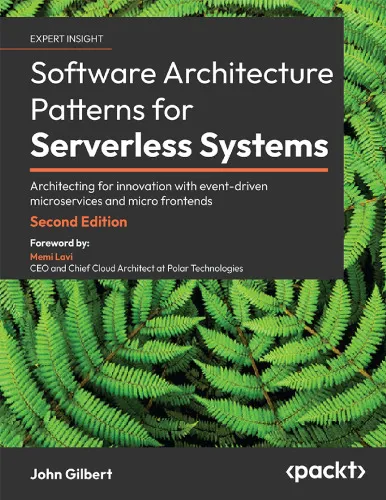
Book guide and evaluation
EXPERT INSIGHT
John Gilbert
English
Unordered
Unordered
4.6 / 5
0 reviews
2024
Published
689 / 488
pages
91
views
Delve into the second edition to master serverless proficiency and explore new chapters on security techniques, multi-regional deployment, and optimizing observability.Key Features Gain insights from a seasoned CTO on best practices for designing enterprise-grade software sy
Before you read
What will you get from this book?
Delve into the second edition to master serverless proficiency and explore new chapters on security techniques, multi-regional deployment, and optimizing observability.Key Features Gain insights from a seasoned CTO on best practices for designing enterprise-grade software systems Deepen your understanding of system reliability, maintainability, observability, and scalability with real-world examples Elevate your skills with software design patterns and architectural concepts, including securing in-depth and running in multiple regions. Book DescriptionOrganizations undergoing digital transformation rely on IT professionals to design systems to keep up with the rate of change while maintaining stability. With this edition, enriched with more real-world examples, you'll be perfectly equipped to architect the future for unparalleled innovation.This book guides through the architectural patterns that power enterprise-grade software systems[...]while exploring key architectural elements (such as events-driven microservices, and micro frontends) and learning how to implement anti-fragile systems.First, you'll divide up a system and define boundaries so that your teams can work autonomously and accelerate innovation. You'll cover the low-level event and data patterns that support the entire architecture while getting up and running with the different autonomous service design patterns.This edition is tailored with several new topics on security, observability, and multi-regional deployment. It focuses on best practices for security, reliability, testability, observability, and performance. You'll be exploring the methodologies of continuous experimentation, deployment, and delivery before delving into some final thoughts on how to start making progress.By the end of this book, you'll be able to architect your own event-driven, serverless systems that are ready to adapt and change.What you will learn Explore architectural patterns to create anti-fragile systems. Focus on DevSecOps practices that empower self-sufficient, full-stack teams Apply microservices principles to the frontend Discover how SOLID principles apply to software and database architecture Gain practical skills in deploying, securing, and optimizing serverless architectures Deploy a multi-regional system and explore the strangler pattern for migrating legacy systems Master techniques for collecting and utilizing metrics, including RUM, Synthetics, and Anomaly detection. Who this book is forThis book is for software architects who want to learn more about different software design patterns and best practices. This isn't a beginner's manual - you'll need an intermediate level of programming proficiency and software design experience to get started.You'll get the most out of this software design book if you already know the basics of the cloud, but it isn't a prerequisite.Table of Contents Architecting for Innovations Defining Boundaries and Letting Go Taming the Presentation Tier Trusting Facts and Eventual Consistency Turning the Cloud into the Database A Best Friend for the Frontend Bridging Intersystem Gaps Reacting to Events with More Events Running in Multiple Regions Securing Autonomous Subsystems in Depth Choreographing Deployment and Delivery Optimizing Observability Don't Delay, Start Experimenting
Ask this book
Your question is answered in the context of this title and author. Each answer uses 2 points.
Sign in to ask the book assistant.
Reader reviews
0 reviews, 4.6 average out of 5
No reviews yet
If you have read this book, help the next reader with your experience.
Write a review
Sign in to publish a review.
Reader questions and answers
Ask a focused question and learn from the community.
Sign in to ask or answer a question.
No questions yet
Be the first to ask a clear, useful question.
What to read next
Related references that continue this learning path.



Biology of the Fungal Cell
Nicholas P. Money (auth.),Professor Dr. Richard J. Howard,Professor Dr. Neil A. R. Gow (eds.)
2001
View book