Book guide and evaluation
Euclid's Elements
Fitzpatrick R. (ed.)
English
Beginner
Mathematics
4.5 / 5
0 reviews
2007
Published
546
pages
519
views
Introduction to Euclid's Elements Euclid's "Elements" is one of the most influential works in the history of mathematics, laying the groundwork for geometry as we know it today. Composed around 300 BC, this comprehensive treatise spans thirteen books and covers a remarkabl
Before you read
What will you get from this book?
Introduction to Euclid's Elements
Euclid's "Elements" is one of the most influential works in the history of mathematics, laying the groundwork for geometry as we know it today. Composed around 300 BC, this comprehensive treatise spans thirteen books and covers a remarkable range of topics from planar geometry to number theory.
Detailed Summary of the Book
The "Elements" is organized into thirteen books, each tackling specific mathematical concepts and methodologies:
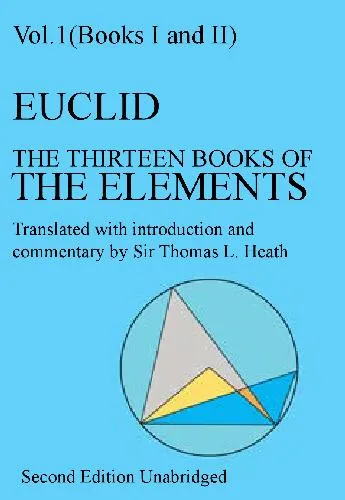
- Books I to IV deal with plane geometry, emphasizing the essential principles of shapes and figures and introducing the theory of parallel lines, proportions, and congruence.
- Book V explores the general theory of proportion, a cornerstone in mathematical reasoning and problem-solving.
- Books VI to X extend the concepts of ratio and proportion to planar figures, leading to the methodology for comparisons in geometric magnitude.
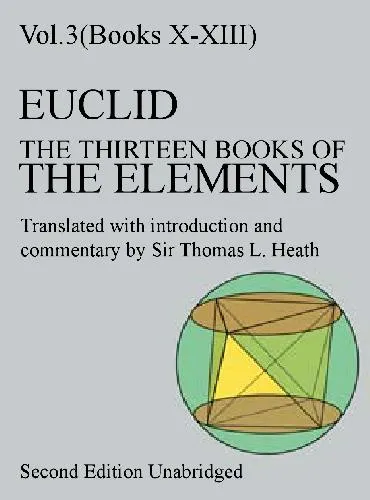
- Books XI to XIII delve into three-dimensional geometry, discussing solids like spheres, cones, and cylinders, culminating with the celebrated classification of the five Platonic solids.
The brilliance of Euclid’s "Elements" lies not only in its content but also in its rigorous deductive structure, influencing centuries of mathematical teaching and thought.
Key Takeaways
Euclid's "Elements" is more than a textbook; it's a philosophical exploration of mathematics:
- Foundational Principles: The work introduces basic axioms and postulates, from which all geometric truths are deduced, embodying a model of logical reasoning.
- Mathematical Rigor: The elements demonstrate the importance of proofs in mathematics, setting a precedent for future mathematical works.
- Applied Geometry: The systematic treatment of geometric concepts in "Elements" laid groundwork applicable to various fields including physics, engineering, and architecture.
Famous Quotes from the Book
Here are some noteworthy excerpts that encapsulate the essence of the "Elements":
"The whole is greater than the part."
"Things which are equal to the same thing are also equal to one another."
These quotes highlight Euclid's logical approach and his long-lasting impact on the precision of mathematical language.
Why This Book Matters
Euclid's "Elements" transcends its immediate mathematical significance, forming a cornerstone of Western science and philosophy:
- Educational Impact: For over two millennia, the "Elements" served as the primary textbook for teaching geometry, signifying its pivotal role in mathematical education.
- Cultural Legacy: Its application extends beyond mathematics, influencing arts, logic, and philosophy, proving its timeless relevance across disciplines.
- Trailblazer for Modern Mathematics: The deductive structure and rigorous proofs in "Elements" have inspired countless mathematicians and led to significant advancements in mathematical theory.
In summary, Euclid’s "Elements" is not merely a collection of geometric teachings but a profound legacy of scientific thought, underpinning extensive developments since its inception.
Ask this book
Your question is answered in the context of this title and author. Each answer uses 2 points.
Sign in to ask the book assistant.
Reader reviews
0 reviews, 4.5 average out of 5
No reviews yet
If you have read this book, help the next reader with your experience.
Write a review
Sign in to publish a review.
Reader questions and answers
Ask a focused question and learn from the community.
Sign in to ask or answer a question.
No questions yet
Be the first to ask a clear, useful question.
What to read next
Related references that continue this learning path.