Book guide and evaluation
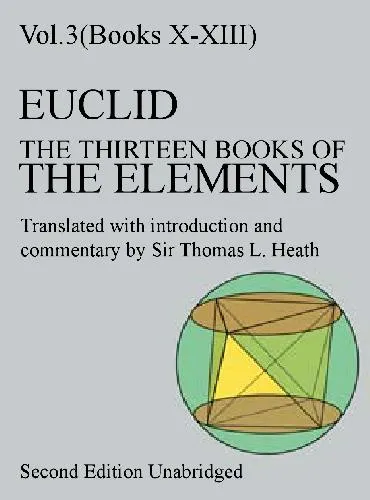
Thirteen Books of Euclid's Elements. Books X-XIII
Heath
English
Beginner
Mathematics
4.5 / 5
0 reviews
-
Published
558
pages
550
views
Introduction to 'Thirteen Books of Euclid's Elements. Books X-XIII' Discover Euclid’s profound insights into geometry and mathematics through the meticulous work presented in the last four books of his seminal work, 'Elements.' Detailed Summary Euclid's 'Elements' is a
Before you read
What will you get from this book?
Introduction to 'Thirteen Books of Euclid's Elements. Books X-XIII'
Discover Euclid’s profound insights into geometry and mathematics through the meticulous work presented in the last four books of his seminal work, 'Elements.'
Detailed Summary
Euclid's 'Elements' is a cornerstone in the history of mathematics, offering foundational insights into geometry and number theory. Books X through XIII are particularly significant as they cover some of the more complex areas of mathematics. Book X deals extensively with irrational numbers, an area that, even today, continues to intrigue mathematicians. Within its densely packed pages, Euclid classifies irrational numbers and examines their properties with rigor.
In Book XI, Euclid transitions from planar geometry to the rigorous three-dimensional space, establishing the principles of solid geometry. Following this exploration, Book XII applies the method of exhaustion, a precursor to integral calculus, to determine areas and volumes of geometric shapes such as circles, spheres, and cones. Lastly, Book XIII culminates with a study of the five Platonic solids, not only in terms of their geometric properties but also in their philosophical significance, emphasizing Euclid’s comprehensive approach to intertwining mathematics with the natural world.
Key Takeaways
- Euclid's innovative approach to classifying irrational numbers laid the groundwork for advanced mathematical concepts.
- His examination of three-dimensional figures in Book XI was foundational to the development of solid geometry.
- The method of exhaustion presented in Book XII foreshadowed the integral calculus techniques used today.
- The exploration of Platonic solids in Book XIII showcased how mathematical constructs intersected with philosophical ideas of the time.
Famous Quotes from the Book
"The whole is greater than the part."
"There are things which are equal to the same thing, and also equal to one another."
Why This Book Matters
'Thirteen Books of Euclid's Elements' occupies a critical role in the history of mathematics and education. These texts do more than merely catalog geometric principles; they demonstrate the scope and elegance of logical reasoning. Euclid's systematic approach not only unified existing mathematical knowledge of his time but also established a template for future mathematical exploration and education.
This book continues to be relevant as it underpins vast areas of mathematics taught today, from basic geometry to advanced theoretical fields. Furthermore, the geometrical principles laid down in these works extend beyond academic discipline, permeating architecture, engineering, physics, and many other fields, thus signifying Euclid’s enduring legacy.
Ask this book
Your question is answered in the context of this title and author. Each answer uses 2 points.
Sign in to ask the book assistant.
Reader reviews
0 reviews, 4.5 average out of 5
No reviews yet
If you have read this book, help the next reader with your experience.
Write a review
Sign in to publish a review.
Reader questions and answers
Ask a focused question and learn from the community.
Sign in to ask or answer a question.
No questions yet
Be the first to ask a clear, useful question.
What to read next
Related references that continue this learning path.