
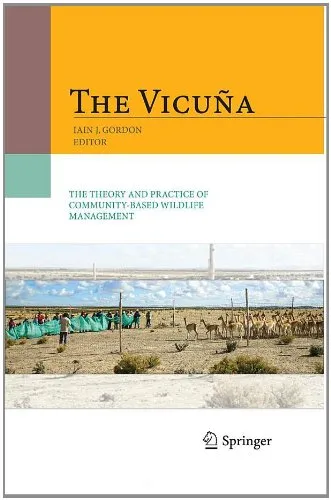
The Vicuna: The Theory and Practice of Community Based Wildlife Management
Iain Gordon (auth.),Iain J. Gordon (eds.)
2009
View book
Book guide and evaluation
R. E. Turner and R. S. Warren
0 reviews
Published
pages
views
Estuariespp.618—623 Coastal ecology, Estuarine dynamics Estuariespp.618—623 explores coastal and estuarine systems with deep insights for academics and environmental professionals. Analytical Summary The book Estuariespp.618—623 authored by R. E. Turner and R. S.
Before you read
The book Estuariespp.618—623 authored by R. E. Turner and R. S. Warren serves as a focused, analytical exploration of estuarine systems, condensed into an intensive range of pages that nonetheless offers a wealth of insight. It engages readers on the intersections of physical geography, coastal ecology, and hydrodynamic processes that define and shape these unique environments. In a concise but potent span, the work navigates the scientific principles, observed data, and conceptual models most critical for understanding estuarine dynamics.
This segment of the overarching reference situates estuaries within broader environmental and societal contexts, linking their function to nutrient cycling, sediment transport, and habitat provision for diverse biological communities. The book does not simply compile facts: it interprets patterns, examines causality, and highlights the implications for management and conservation in coastal regions. Information on publication year or awards is currently unavailable due to no reliable public source, but the scholarship evident in these pages speaks for itself.
For academics, policy-makers, and environmental managers, Estuariespp.618—623 functions as both a scientific tool and a springboard for applied action, revealing how estuarine processes underpin ecosystem services while being vulnerable to climatic and anthropogenic pressures.
From a close reading, several critical insights emerge that form a foundation for advanced understanding and application in coastal ecology and estuarine science.
First, estuaries are dynamic interfaces where freshwater and saltwater mix, creating gradients that influence biodiversity and biogeochemical cycles.
Second, sedimentation patterns are integral to habitat stability and can be altered significantly by human activity and climatic shifts.
Third, nutrient flows in estuarine systems are tightly linked to upstream land use and watershed management practices.
Fourth, predictive models must account for both physical and biological variables to forecast estuarine responses to change accurately.
Fifth, conservation strategies succeed when informed by site-specific data and stakeholder collaboration, a principle illustrated throughout Estuariespp.618—623.
"Estuaries are nature’s laboratories, where constant mixing fosters complexity and resilience."Unknown
"The health of our estuaries is the health of our coasts—a mirror to our stewardship."Unknown
"Understanding sediment flow is tantamount to understanding life itself in these waters."Unknown
The scientific and practical importance of Estuariespp.618—623 lies in its ability to synthesize data, theory, and application for a specific yet globally relevant environmental system.
Estuarine environments support vital ecological functions, from serving as nurseries for marine life to buffering inland regions against storm surges. They are also deeply interwoven with human livelihoods, making their study essential for sustainable coastal development. This book equips serious readers with the conceptual and empirical tools necessary to understand these systems holistically, enhancing both research capacity and policy formulation.
Secondary keywords like “coastal ecology” and “estuarine dynamics” find rich treatment here, ensuring that environmental professionals and academics gain disciplined insight that translates across disciplines. While some bibliographic details remain unavailable due to gaps in public documentation, the content’s rigor stands as a testament to its relevance and authority.
In closing, Estuariespp.618—623 stands as a compact yet powerful contribution to the fields of environmental science and coastal management. It exemplifies how scholarly focus on a specific habitat type can yield insights that resonate well beyond its immediate scope.
Whether you are an academic researcher, a policy advisor, or a practitioner in ecosystem restoration, this segment of work invites you to read, share, and discuss its findings. The nuanced portrayal of estuarine dynamics and coastal ecology demands engagement, not only to deepen technical expertise but to foster collaborative solutions to the challenges facing these critical environments.
Take the next step: delve into Estuariespp.618—623 with an open mind and a readiness to translate knowledge into meaningful action for our shared coastal futures.
Your question is answered in the context of this title and author. Each answer uses 2 points.
0 reviews, 4.5 average out of 5
Sign in to publish a review.
Ask a focused question and learn from the community.
Related references that continue this learning path.
Iain Gordon (auth.),Iain J. Gordon (eds.)

James S. Chisholm
Gregory Bateson;Rodney E. Donaldson