
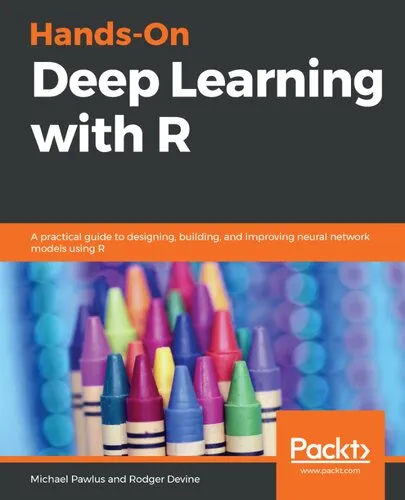
Hands-On Deep Learning with R: A practical guide to designing, building, and improving neural network models using R
Michael Pawlus,Rodger Devine
2020
View book
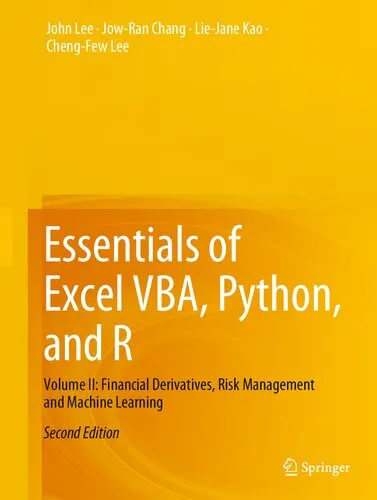
Book guide and evaluation
John Lee,Jow-Ran Chang,Lie-Jane Kao
0 reviews
Published
pages
views
Introduction to "Essentials of Excel VBA, Python, and R: Volume II: Financial Derivatives, Risk Management and Machine Learning, 2nd Edition" Welcome to the second edition of "Essentials of Excel VBA, Python, and R: Volume II," a comprehensive guide designed to empower profess
Before you read
Welcome to the second edition of "Essentials of Excel VBA, Python, and R: Volume II," a comprehensive guide designed to empower professionals in finance, risk management, and machine learning. This edition builds upon the foundational concepts presented in the first volume, expanding on advanced topics with a clear, practice-oriented approach.
In this edition, we delve deeper into the intricate world of financial derivatives and risk management, with a special focus on how Excel VBA, Python, and R can be leveraged to address complex challenges in these fields. The book is structured to guide readers through a journey of analytical thinking and problem-solving, starting with the fundamentals of derivative pricing models, moving towards sophisticated risk management strategies, and concluding with the integration of machine learning techniques.
The first section revisits essential pricing concepts, ensuring a solid foundation before exploring advanced derivative structures such as options, futures, and swaps. By using Excel VBA, readers gain hands-on experience in developing pricing spreadsheets that demonstrate the practical application of theoretical models.
Subsequent chapters introduce the reader to Python and R programming, providing a vibrant intersection of finance and technology. This includes detailed tutorials on building custom financial models, optimizing portfolios, and performing robust risk assessments. Furthermore, there's an emphasis on real-world data analysis, encouraging an applied understanding of complex financial instruments.
The final section of the book is dedicated to cutting-edge machine learning techniques and their use in financial contexts. We cover algorithms ranging from supervised learning to deep learning, illustrating their utility in predictive modeling and decision-making processes. Examples and case studies highlight the practical implementation of these techniques, providing readers with an insight into the future of financial analysis.
"In the realm of finance, where uncertainty and risk are constant companions, it is the blend of technology and analytical rigor that lights the path to opportunities."
"Excel VBA, Python, and R are not just tools—they are extensions of one's ability to navigate and master the complexities of financial markets."
This book holds significance not just as a learning resource, but as a bridge between academia and industry, equipping professionals and students alike with the necessary skills to excel in the digital economy. In finance, where data drives decisions, mastering tools like Excel VBA, Python, and R is indispensable. As markets become increasingly algorithm-driven, there's never been a more crucial time for financial professionals to adapt.
Moreover, the integration of machine learning into this realm adds a forward-thinking dimension. Proficiency in these areas not only heightens one’s analytical capabilities but also enhances career prospects in an ever-evolving financial landscape. By merging theory with practice, this book ensures that readers are not only participants but innovators in the financial domain.
Your question is answered in the context of this title and author. Each answer uses 2 points.
0 reviews, 4.3 average out of 5
Sign in to publish a review.
Ask a focused question and learn from the community.
Related references that continue this learning path.
Michael Pawlus,Rodger Devine
Stephen F. Elston
Peter Bruce,Andrew Bruce,Peter Gedeck