Book guide and evaluation
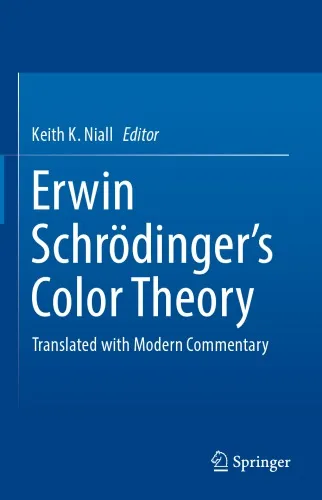
Erwin Schrödinger’s Color Theory
Erwin Schrödinger;Keith K. Niall (ed.)
English
Beginner
Painting & Drawing
4.5 / 5
0 reviews
2017
Published
197
pages
501
views
Introduction to Erwin Schrödinger’s Color Theory Erwin Schrödinger is widely known for his pioneering contributions to quantum mechanics, but not everyone is aware of his profound exploration into the domain of color theory. "Erwin Schrödinger’s Color Theory" i
Before you read
What will you get from this book?
Introduction to Erwin Schrödinger’s Color Theory
Erwin Schrödinger is widely known for his pioneering contributions to quantum mechanics, but not everyone is aware of his profound exploration into the domain of color theory. "Erwin Schrödinger’s Color Theory" is a compelling examination of color perception, the interplay of light and matter, and the implications of this knowledge on both scientific and philosophical realms. This book serves as both an homage to Schrödinger's interdisciplinary genius and a valuable resource for scholars interested in the intersection of physics, biology, and art.
Detailed Summary of the Book
Schrödinger’s inquiry into color theory delves into the psychophysical processes that enable us to perceive color. He examines how different spectra of light are interpreted by the human eye and brain. The book discusses the physical principles governing light and color, exploring issues like wavelength, the refraction of light, and the role of cones and rods in the human retina.
What makes this exposition particularly unique is Schrödinger’s ability to synthesize insights from both natural sciences and the humanities. He considers historical contexts and philosophical questions about the nature of color and perception, making it a multidisciplinary exploration. Schrödinger also challenges some early 20th-century assumptions about color, laying the groundwork for new approaches in both theoretical and applied sciences.
Key Takeaways
- Understanding the dual nature of light as both wave and particle deepens our comprehension of color perception.
- Psychophysical processes are integral to not just scientific interpretations, but artistic representations as well.
- Schrödinger encourages readers to engage with complex ideas across disciplinary boundaries, supporting the notion of unified knowledge.
Famous Quotes from the Book
"The mind's eye, much like the physical eye, sees the world through the lens of learned perception."
"Color cannot simply be reduced to waves and particles; it is a phenomenon of perception requiring both physical and psychological analysis."
Why This Book Matters
This book is essential reading for those interested in interdisciplinary studies and the history of scientific thought. Schrödinger elucidates complex concepts in an accessible manner, advocating for an integrated approach to understand phenomena like color. By critically analyzing how we perceive color, Schrödinger adds depth to the philosophical discourse about reality, perception, and science's role in shaping both. "Erwin Schrödinger’s Color Theory" remains a seminal work, inspiring ongoing research and debate in areas ranging from cognitive science to aesthetics.
Ask this book
Your question is answered in the context of this title and author. Each answer uses 2 points.
Sign in to ask the book assistant.
Reader reviews
0 reviews, 4.5 average out of 5
No reviews yet
If you have read this book, help the next reader with your experience.
Write a review
Sign in to publish a review.
Reader questions and answers
Ask a focused question and learn from the community.
Sign in to ask or answer a question.
No questions yet
Be the first to ask a clear, useful question.
What to read next
Related references that continue this learning path.
Directional processing of color images theory and experimental results
Trahanias,Karakos,Venetsanopoulos