
An Introduction to Statistical Learning with Applications in R
Gareth James,Daniela Witten,Trevor Hastie,Robert Tibshirani
2013
View book
Book guide and evaluation
Pearl J.
0 reviews
Published
pages
views
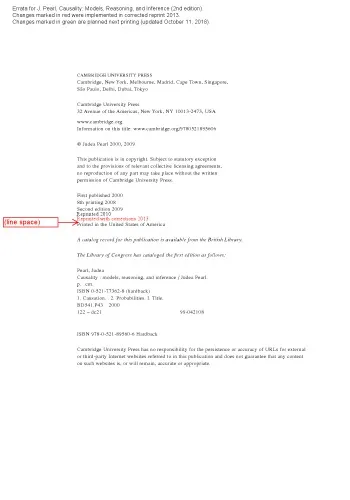
Introduction to "Errata for J. Pearl, Causality: Models, Reasoning, and Inference" Published as a companion to the groundbreaking work "Causality: Models, Reasoning, and Inference" by Judea Pearl, this errata book acts as an essential reference for researchers, stu
Before you read
Published as a companion to the groundbreaking work "Causality: Models, Reasoning, and Inference" by Judea Pearl, this errata book acts as an essential reference for researchers, students, and professionals working in the areas of causal inference, artificial intelligence, machine learning, statistics, and related fields. It aims to provide clarifications, corrections, and insights that enrich the reader's understanding of one of the most influential works in modern scientific inquiry. In this introduction, we will delve deeply into the purpose and key features of this book.
The "Errata for J. Pearl, Causality" is an organized compendium of revisions and enhancements, categorized by chapter, to refine the original text and clarify its concepts. It meticulously addresses typographical errors, mathematical inconsistencies, and ambiguities found in the first and subsequent editions of "Causality: Models, Reasoning, and Inference." This book is not merely a "corrections manual" but a comprehensive guide that expands on certain concepts that readers—or even practitioners—may have found challenging in the original volume.
Spanning key topics such as the probability calculus, structural equation modeling, counterfactuals, and causal diagrams, the errata enhances the accessibility of Pearl's original work. It focuses on empowering readers to rigorously interpret and apply causal inference in solving real-world problems. By acknowledging potential pitfalls in interpretation and providing amended explanations, the book ensures that the revolutionary ideas presented in "Causality" achieve their full impact across diverse research and application domains.
This errata book underscores several key observations about causal reasoning and inference:
"Causality is not a property of data, but rather a property of the processes that generate the data."
"The power of understanding causality lies in its ability to bridge data to questions of action—what will happen if I do X?"
The "Errata for J. Pearl, Causality" occupies a crucial position among academic resources, as it not only enhances the reader's comprehension of Pearl's work, but also reflects the importance of intellectual integrity in scientific scholarship. It invites readers to critically engage with causal theories and equips them with the insights necessary to question, validate, and build upon foundational knowledge.
In a world increasingly reliant on data-driven decision-making, understanding causality transcends academic theory; it informs medical research, public policy, and technological innovation. By ensuring the accuracy and clarity of a pioneering work, the errata significantly contributes to advancing the field of causal inference and its practical applications.
As you explore this companion volume, you’ll gain not only a deeper appreciation of Pearl's landmark contributions but also the tools to build your own rigorous and predictive models of causal relationships in science and society.
Your question is answered in the context of this title and author. Each answer uses 2 points.
0 reviews, 4.5 average out of 5
Sign in to publish a review.
Ask a focused question and learn from the community.
Related references that continue this learning path.
Gareth James,Daniela Witten,Trevor Hastie,Robert Tibshirani
Richard McElreath